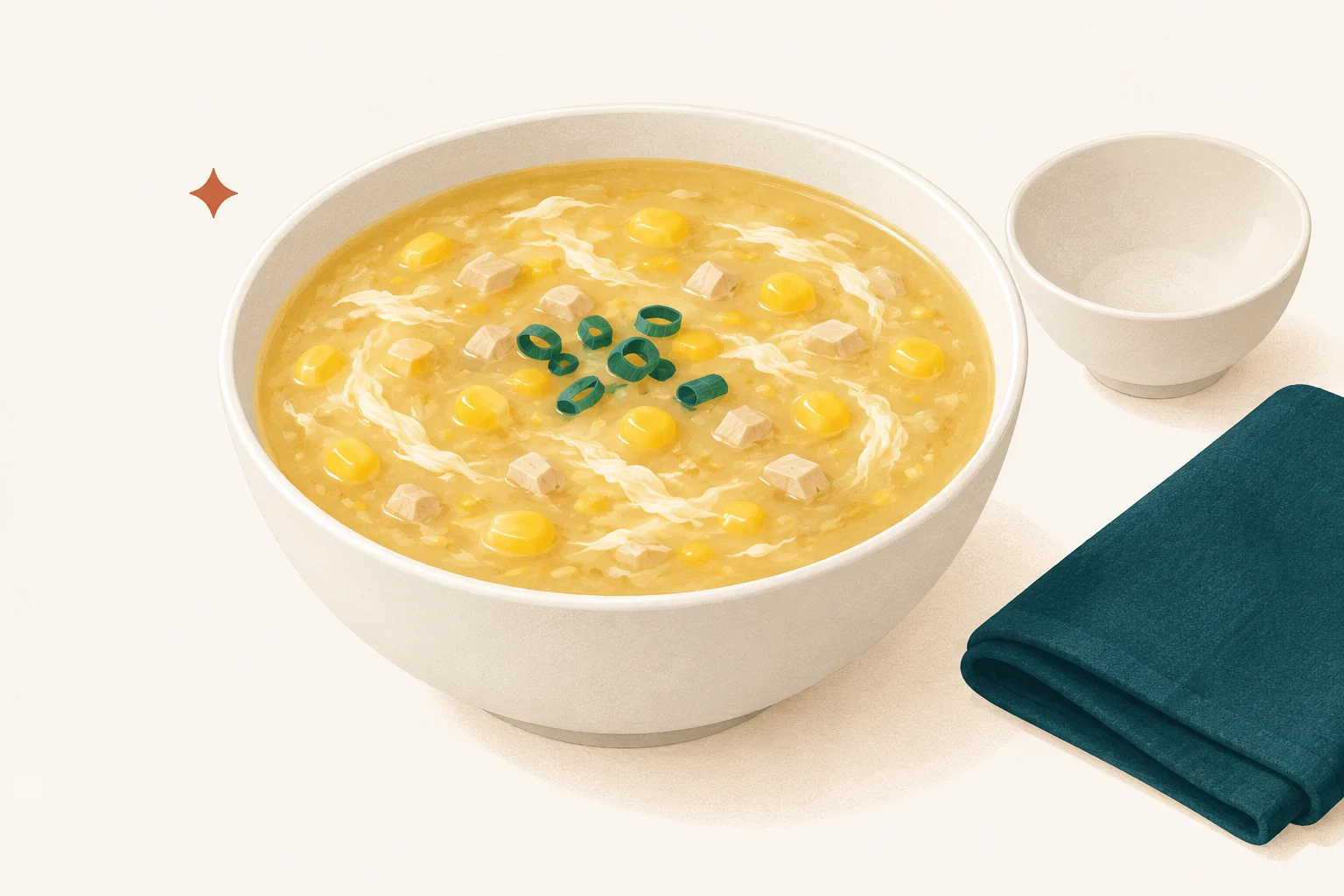
Cantonese chicken and sweet corn soup combines finely cut chicken, sweet corn,
and pale egg ribbons in a thickened stock that still flows from a ladle. This
version uses cream-style corn for body and whole kernels for texture, so a
beginner does not need to strip or blend fresh corn.
The soup is an approachable one-pan starter, but it is not presented as the one
definitive traditional formula. It is a restaurant-style adaptation of
雞茸粟米羹, built from published Cantonese and Hong Kong versions and adjusted
for a US grocery store.
Verification note: This recipe is source-verified, not kitchen-tested by
Not Hard to Cook. The formulation and timing are an editorial synthesis. Use
the stated visual cues and verify the largest chicken piece at 165°F/74°C.
Why This Recipe Works
- Two corn textures do different jobs: Cream-style corn supplies crushed
corn and body, while thawed whole kernels remain visible in the finished soup. - Small chicken pieces disperse: Pieces no larger than a corn kernel cook
quickly and feel integrated rather than turning the bowl into chunky chicken soup. - The slurry is adjustable: Adding it in stages lets you stop while the soup
still pours, instead of committing to a gluey texture. - Safety has its own cue: Opaque chicken looks done before a thermometer can
confirm it. The largest piece must reach the FDA poultry minimum of
165°F/74°C.
Recipe at a Glance
| Prep | Cook | Additional | Total | Yield | Difficulty |
|---|---|---|---|---|---|
| 20 minutes | 20 minutes | None | 40 minutes | 4 starter servings, about 1 1/2 cups/355 ml each | Easy |
About Cantonese Chicken and Sweet Corn Soup
The Traditional Chinese name used here is 雞茸粟米羹. The dish also appears
on Hong Kong and Cantonese restaurant menus as 雞蓉粟米羹 or with the corn and
chicken words reversed. In each case, the important final character is 羹:
this is a thick soup that should remain fluid, not a dairy cream soup or a
long-simmered clear broth.
An assembled Jyutping reading is gai1 jung4 suk1 mai5 gang1. CantoDict lists
粟米羹 as suk1 mai5 gang1; because no reliable phrase-level recording was
located, this is an editorial assembly, not a native-audio citation.
Contemporary recipes associated with Hong Kong and Cantonese restaurant cooking
agree on corn, fine chicken, a thickened stock, and often egg ribbons. They vary
on fresh, frozen, canned, or cream-style corn and on the exact seasonings. That
variation is why this exact grocery-store formulation is labeled a
restaurant-style adaptation, not “the authentic recipe.”
Equipment
- 3-quart/2.8-litre or larger saucepan: A larger Dutch oven also works.
- Sharp knife and cutting board: Reserve the board for raw chicken, then
clean it before cutting scallion. - One medium and two small bowls: Keep chicken, slurry, and eggs separate.
- Ladle and whisk or fork: Use these to loosen chicken and beat the eggs.
- Thin-probe instant-read thermometer: A slim probe is the practical way to
check a small piece of chicken at its center.
Ingredients
Chicken
- 140 g (5 oz) boneless skinless chicken breast, cut into pieces no larger than
1/4 inch/6 mm - 1 tablespoon (15 ml) cold water
- 1 teaspoon (5 ml) light soy sauce
- 1 teaspoon (3 g) cornstarch
Soup
- 4 cups (950 ml) unsalted or lower-sodium chicken stock
- 1 can cream-style sweet corn, about 425 g (15 oz), not drained
- 1 cup (165 g) frozen sweet corn kernels, thawed
- 2 tablespoons (16 g) cornstarch
- 2 tablespoons (30 ml) cold water
- 2 large eggs, lightly beaten
- 1/8 teaspoon ground white pepper, plus more to serve if desired
- 1 teaspoon (5 ml) toasted sesame oil
- Up to 1/4 teaspoon fine salt, only if needed after tasting
- 1 medium scallion, thinly sliced, optional
Substitutions and allergens: This formulation contains egg, soy, and
sesame. Light soy sauce often contains wheat; stock and canned corn may also
contain wheat, soy, milk, celery, or other allergens depending on the brand.
Check every label and account for cross-contact in your kitchen. Boneless
thigh can replace breast but may need more time. Labeled wheat-free tamari can
replace soy sauce, but no universal gluten-free or allergen-free claim is made.
Mise en Place
- Put the raw chicken board and bowl on one side of the work area. Keep the
egg, scallion, serving ladle, and clean thermometer away from that zone. - Cut the chicken into pieces no larger than 1/4 inch/6 mm. If the breast is
difficult to cut, chill it briefly in the freezer until firm but not frozen solid. - Coat the chicken with 1 tablespoon water, the light soy sauce, and 1 teaspoon
cornstarch. Wash your hands, then clean the knife, board, and work surface. - Mix the 2 tablespoons cornstarch and 2 tablespoons cold water in a clean
bowl. Beat the eggs in another bowl and slice the optional scallion. - Open the cream-style corn, thaw the whole kernels, measure the stock, and
place every addition within reach. The last stages move quickly.
How to Make Cantonese Chicken and Sweet Corn Soup
- Prepare and season the chicken. On the raw-poultry board, cut 140 g/5 oz
chicken into pieces no larger than 1/4 inch/6 mm. Mix with 1 tablespoon cold
water, 1 teaspoon light soy sauce, and 1 teaspoon cornstarch until no dry
starch remains. Clean the chicken-contact surfaces and wash your hands. - Stage the slurry and egg. Stir 2 tablespoons cornstarch with 2 tablespoons
cold water until smooth. In a separate bowl, lightly beat the 2 eggs. Slice
the optional scallion on a clean board. - Heat the corn base. Combine the stock, cream-style corn, whole kernels,
and white pepper in the saucepan. Bring to a low boil over medium-high heat,
scraping along the bottom, then reduce to a steady simmer for 5 minutes. - Loosen and cook the chicken. Ladle about 1/2 cup/120 ml hot soup into the
chicken bowl and stir at once to separate the pieces. Pour everything back
into the simmering pot while stirring. Simmer for 3 to 5 minutes. Probe the
largest piece on a clean spoon or plate; its center must reach 165°F/74°C. - Thicken gradually. Re-stir the slurry because the starch settles. Pour in
half while stirring. Simmer for 30 seconds, then add more a tablespoon at a
time until the soup lightly coats a spoon but still pours. Simmer 1 minute
after the final addition. Discard any unused slurry. - Form the egg ribbons. Lower the heat to gentle bubbling. Stir slowly in
one direction, pour the eggs in a thin stream, then stop stirring for 15
seconds. Make one or two slow circles to separate the set ribbons. - Finish and serve. Remove the pot from the heat and add the sesame oil.
Taste before adding salt; the stock, soy sauce, and corn may already supply
enough. Divide among four bowls and add the optional scallion.
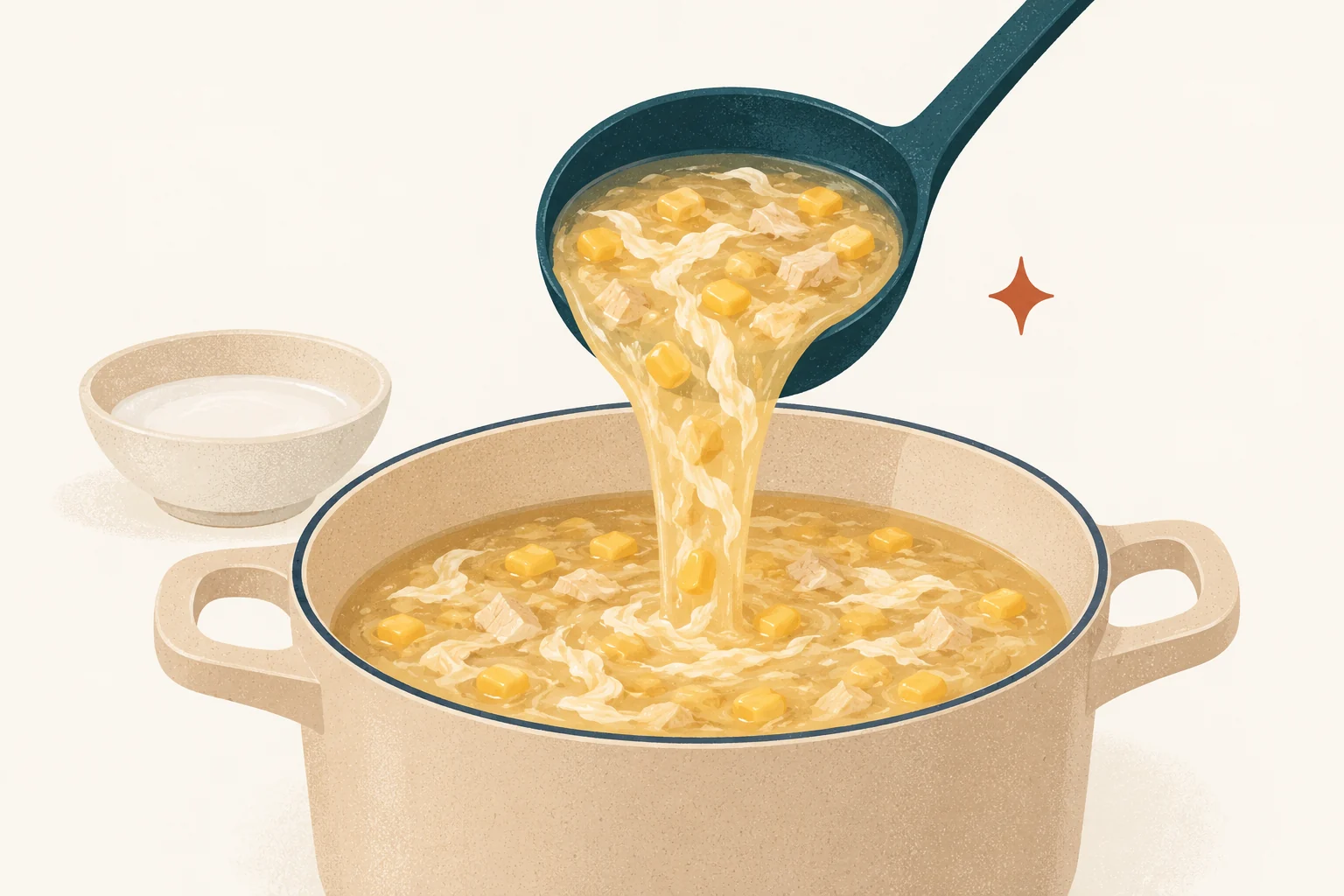
The soup should coat the ladle lightly while still pouring in a continuous stream.
Critical Technique Notes
Keep the soup thick but flowing
Starch needs a brief simmer before its full effect is visible. The right texture
lightly coats a spoon and falls in a continuous stream. Cream-style corn brands
vary, so you may not need every drop of slurry. If the soup becomes too thick,
whisk in hot unsalted stock or water 1 tablespoon at a time.
Separate the chicken before it sets
Cornstarch-coated chicken clings together. Loosen it with hot soup and stir as
it returns to the pan. Wash the raw-chicken bowl before any cooked-food use.
Let the egg set before the final stir
Fast whisking makes tiny flecks. For ribbons, build one slow current, pour in a
thin stream, and pause so the egg sets in the thickened soup.
Let the stock decide the salt
Stock, soy sauce, and cream-style corn vary in sodium. Begin lower-sodium and
taste after adding sesame oil instead of fixing the salt at the start.
Troubleshooting
| Problem | Likely cause | Fix now | Prevent next time |
|---|---|---|---|
| Soup is gluey | Too much slurry or no pause before judging | Whisk in hot unsalted stock or water 1 tablespoon at a time | Add half the slurry first and simmer 30 seconds |
| Soup stays thin | Cream-style corn is loose or slurry settled | Re-stir remaining slurry; add 1 tablespoon and simmer 1 minute | Measure starch level and stir immediately before pouring |
| Chicken forms clumps | Coated pieces went into the pot together | Separate gently with the ladle while simmering; verify 165°F/74°C | Loosen chicken with hot soup before it enters the pot |
| Egg becomes tiny flecks | Soup was whisked quickly during pouring | The soup is still usable; stop stirring so the remaining egg can set | Pour slowly into one broad current, then pause 15 seconds |
| Soup tastes too salty | Stock, soy sauce, or canned corn was high-sodium | Dilute with unsalted stock or water, then recheck thickness | Choose lower-sodium stock and add salt only after tasting |
Variations
Fresh or frozen corn base
Replace the cream-style corn with 2 cups/330 g thawed frozen or fresh kernels.
Pulse them with 1/2 cup/120 ml of the measured stock until about half the kernels
break down, then use the mixture in the base. The flavor will be fresher and the
soup may require more of the prepared slurry.
Cooked-chicken shortcut
Use 140 g/5 oz plain cooked chicken in 1/4-inch/6-mm pieces. Add it after the
corn base simmers and heat it to 165°F/74°C before thickening. Count its prior
storage time within the 3–4-day leftovers limit.
Serving Suggestions
Serve it before bok choy with oyster sauce or beside
rice made with the site’s repeatable steamed rice
method.
For ingredient-label help, see the Cantonese pantry essentials
guide. To compare this
thick soup with other weeknight formats, use the live quick Cantonese soups and
noodle dishes guide.
Storage and Reheating
- Refrigerate: Transfer the soup to shallow covered containers and
refrigerate within 2 hours. Keep at 40°F/4°C or below and use within 3–4 days. - Freeze: For food-safety planning, soup can be frozen, but this egg-and-
cornstarch texture may separate or thin after thawing. Freeze in small airtight
portions for up to 2–3 months for quality, thaw in the refrigerator, and whisk
while reheating. - Reheat: Bring the soup to a boil while stirring so the thick base heats
evenly, and verify 165°F/74°C. Add a little water or unsalted stock if it
has tightened. Reheat only the portion you plan to serve.
These limits follow FDA cooling and reheating
guidance
and USDA FSIS leftovers guidance.
Frequently Asked Questions
Is cream-style corn the same as creamed corn with dairy?
Not necessarily. It usually means crushed corn in thick corn liquid, but brands
vary. Check the ingredient and allergen label rather than assuming either way.
Can I make the soup with only frozen corn?
Yes. Pulse 2 cups/330 g thawed kernels with 1/2 cup/120 ml measured stock until
about half break down. Without the canned base, the soup may need more slurry.
How thick should Cantonese chicken corn soup be?
It should lightly coat a spoon but pour in a continuous stream. The texture is
thicker than an ordinary broth and looser than gravy or pudding. Judge only
after the starch has simmered for at least 30 seconds.
Can I leave out the egg?
Yes. Omit it and proceed from thickening to finishing. The soup will have less
body and no ribbons, so it is a variation rather than the exact formulation on
this page. Check the packaged ingredients separately if egg avoidance matters.
Recipe Card
Cantonese Chicken and Sweet Corn Soup (雞茸粟米羹)
Restaurant-style adaptation; source-verified and not kitchen-tested by Not Hard
to Cook.
- Prep: 20 minutes
- Cook: 20 minutes
- Total: 40 minutes
- Yield: 4 starter servings, about 1 1/2 cups/355 ml each
- Difficulty: Easy
- Equipment: 3-quart/2.8-litre or larger saucepan; raw-chicken cutting board
and sharp knife; one medium and two small bowls; ladle; whisk or fork;
thin-probe instant-read thermometer
Chicken
- 140 g (5 oz) boneless skinless chicken breast, cut into pieces no larger than
1/4 inch/6 mm - 1 tablespoon (15 ml) cold water
- 1 teaspoon (5 ml) light soy sauce
- 1 teaspoon (3 g) cornstarch
Soup
- 4 cups (950 ml) unsalted or lower-sodium chicken stock
- 1 can cream-style sweet corn, about 425 g (15 oz), not drained
- 1 cup (165 g) frozen sweet corn kernels, thawed
- 2 tablespoons (16 g) cornstarch
- 2 tablespoons (30 ml) cold water
- 2 large eggs, lightly beaten
- 1/8 teaspoon ground white pepper, plus more to serve if desired
- 1 teaspoon (5 ml) toasted sesame oil
- Up to 1/4 teaspoon fine salt, only if needed after tasting
- 1 medium scallion, thinly sliced, optional
Instructions
- Cut the chicken into pieces no larger than 1/4 inch/6 mm. Mix with 1
tablespoon cold water, 1 teaspoon light soy sauce, and 1 teaspoon cornstarch.
Clean every raw-chicken contact surface and wash your hands. - Mix 2 tablespoons cornstarch with 2 tablespoons cold water. Beat the eggs in
another bowl and slice the optional scallion on a clean board. - Bring the stock, cream-style corn, whole kernels, and white pepper to a low
boil in the saucepan, stirring along the bottom. Simmer for 5 minutes. - Loosen the chicken with about 1/2 cup/120 ml hot soup. Return it to the pot
while stirring and simmer 3–5 minutes, until the largest piece reaches 165°F/74°C. - Re-stir the slurry. Add half, simmer 30 seconds, then add more as needed until
the soup coats a spoon but still pours. Simmer 1 minute after the final addition. - Stir the soup slowly in one direction and pour in the eggs in a thin stream.
Pause 15 seconds, then stir once or twice to separate the ribbons. - Remove from the heat, add sesame oil, and taste before adding up to 1/4
teaspoon salt. Garnish with scallion and serve hot.
Storage: Refrigerate in shallow covered containers within 2 hours and use
within 3–4 days. Bring reheated soup to a boil and verify 165°F/74°C. The soup
can be frozen for 2–3 months for quality, but the starch and egg texture may change.
Nutrition Information
Nutrition information has not been independently verified and is not provided.