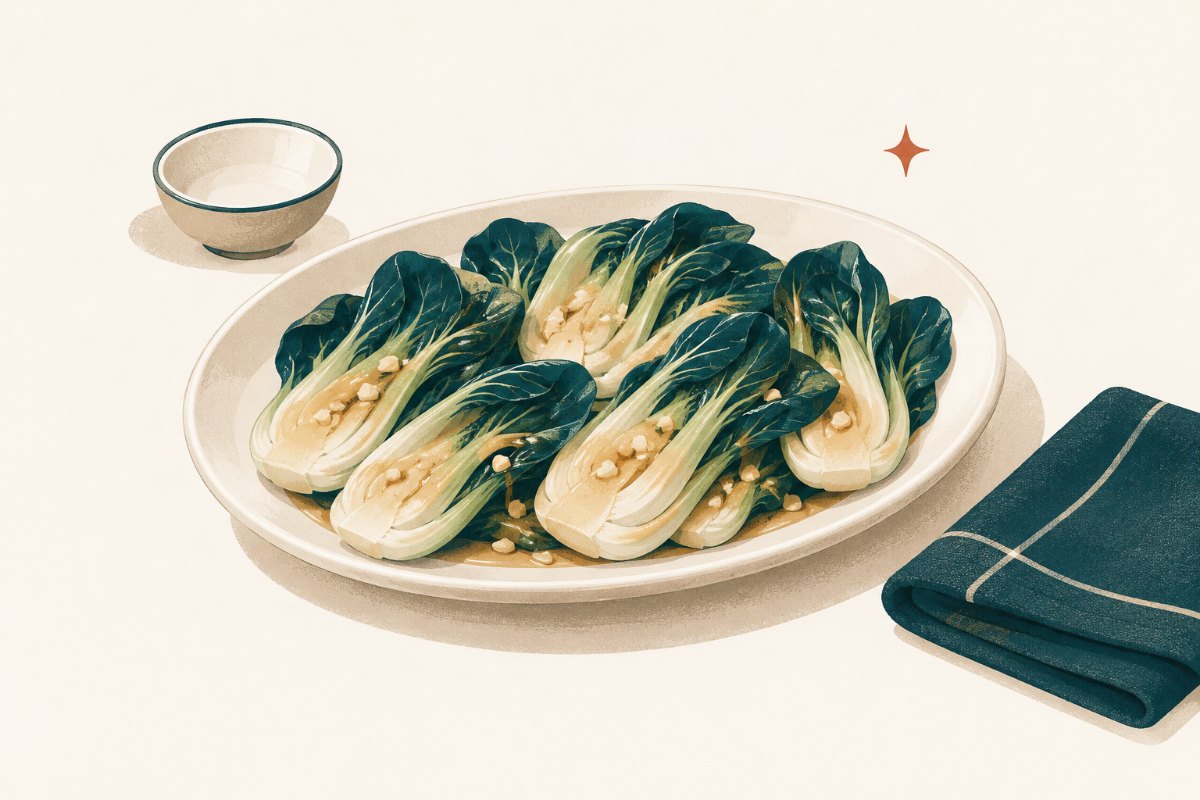
Bok choy with oyster sauce can be a simple vegetable side, but three details decide whether it works: the size of the bok choy, the water left between its layers, and the salt already present in the bottled sauces.
This version uses small halved heads and one cooking vessel. Blanch the bok choy until the stems are crisp-tender, drain it thoroughly, then make a light garlic- oyster sauce in the emptied pan. The 28-minute total includes washing the leaves and bringing the blanching water to a boil.
Verification note: This is a source-verified adaptation, not a recipe kitchen-tested by Not Hard to Cook. The technique, produce handling, and allergen guidance were checked against the sources linked below; the exact formula and timing still need a documented test cook.
Why this recipe works
- Size controls the timing: Small 3–4-inch (7.5–10-cm) heads can stay attached at the core and finish in a short blanch. Larger heads need a different cut.
- The same pan does both jobs: The blanching vessel becomes the sauce pan after the water is poured away and all visible droplets are evaporated.
- Salt stays measurable: Plain blanching water and only 1/2 teaspoon soy leave the oyster sauce as the primary seasoning. No extra salt or sugar is added.
- A thin slurry helps the sauce cling: Cornstarch is mixed with cool water before heating, then re-stirred so it does not settle in the bowl.
Recipe at a glance
| Prep | Cook | Additional | Total | Yield | Difficulty |
|---|---|---|---|---|---|
| 10 minutes | 18 minutes | None | 28 minutes | 4 side-dish servings | Easy |
About bok choy with oyster sauce
Bok choy can be stir-fried, added to soup, or blanched. The Woks of Life’s Chinese vegetable guide specifically documents blanching bok choy and serving it with oyster sauce, and oyster sauce is widely used in Cantonese cooking.
That evidence supports calling this a Cantonese-style blanch-and-dress preparation. It does not establish this exact garlic, soy, and cornstarch formula as the one authentic version, so this page does not make that claim. No standardized Chinese name for this exact adaptation was verified, and none is invented here.
Which bok choy to buy
“Baby bok choy” describes a young harvest stage, not one specific cultivar. UMass Extension distinguishes white-stem or Canton bok choy, with dark green leaves, from green-stem or Shanghai bok choy, with lighter green leaves. Either works here when the heads are only 3–4 inches (7.5–10 cm) long.
Choose firm stems and crisp leaves without extensive yellowing, wilting, or brown spots. Try to buy heads of similar size so they finish together. If only mature bok choy is available, use the staged stem-and-leaf variation below instead of extending this small-head timing blindly.
Equipment
- 4-quart/3.8-litre saucepan or deep 12-inch/30-cm skillet: It needs room for the boiling water and greens without reaching an unsafe fill level.
- Large colander: Drain the heads cut side down. A spider and rimmed tray can work, but the vegetables still need a place to shed water.
- Small bowl and spoon: Mix and re-stir the sauce before it reaches the pan.
- Long-handled tongs or spider: Keep hands away from boiling water while lowering and turning the bok choy.
Ingredients
Bok choy
- 1 pound (454 g) small baby bok choy, 3–4 inches/7.5–10 cm long, halved lengthwise, washed between the layers, and patted dry
- About 2 1/2 quarts (2.4 litres) water for blanching, with no added salt or oil
Garlic-oyster sauce
- 1 1/2 tablespoons (22 ml) Chinese oyster sauce
- 3 tablespoons (45 ml) cool water
- 1/2 teaspoon (2.5 ml) light soy sauce
- 1/2 teaspoon (2.5 ml) cornstarch
- 2 teaspoons (10 ml) neutral cooking oil, such as canola or grapeseed oil
- 2 medium garlic cloves, finely minced (about 2 teaspoons)
Substitutions and allergens: Oyster sauce contains oyster, a mollusc; some brands also contain wheat or soy. Light soy sauce contains soy and commonly wheat. Under US labeling rules, molluscan shellfish such as oyster are not covered by the same statutory major-allergen category as crustacean shellfish, so read the complete ingredient list rather than relying only on a “Contains” line. For a vegetarian version, use 1 1/2 tablespoons vegetarian mushroom stir-fry sauce, omit the light soy at first, then add up to 1/2 teaspoon only after tasting. The result will be mushroom-forward rather than oyster/briny, and the substitute may still contain soy or wheat. Product and kitchen cross-contact varies; this recipe makes no allergen-free claim.
Mise en place
- Trim only the dry end of each base, leaving enough core to hold the leaves together, then halve each small head lengthwise.
- Open the layers under cool running water and rub away visible grit. Swish the halves in a clean bowl of water, lift them out so settled grit stays behind, give them a final running-water rinse, and pat them dry. The FDA advises running water, not soap, detergent, or commercial produce wash.
- Mince the garlic. Mix the oyster sauce, cool water, light soy sauce, and cornstarch until smooth. Place the colander and tongs beside the stove.
How to make bok choy with oyster sauce
- Mix the sauce. In a small bowl, stir together 1 1/2 tablespoons oyster sauce, 3 tablespoons cool water, 1/2 teaspoon light soy sauce, and 1/2 teaspoon cornstarch until no dry starch remains. Keep it beside the stove and plan to stir it again immediately before use.
- Bring the water to a boil. Put about 2 1/2 quarts water in a 4-quart saucepan or deep 12-inch skillet, leaving a safe margin below the rim. Do not add salt or oil. Cover and bring to a full boil over high heat, allowing up to 10 minutes.
- Blanch the bok choy. Lower the bok choy into the boiling water with tongs, holding the thicker stem ends down for 60 seconds. Submerge the leaves and continue cooking for 1–2 minutes, turning once, until the leaves are wilted and a small knife enters the thickest stem with slight resistance.
- Drain thoroughly. Transfer the bok choy to a colander and arrange it cut side down. Shake gently and let it drain while you empty the pan; trapped water would thin the sauce.
- Dry the pan and bloom the garlic. Carefully pour away the hot blanching water. Return the empty pan to medium heat for 30–60 seconds, until visible water droplets have evaporated. Only then add 2 teaspoons neutral oil and the minced garlic; stir for 20–30 seconds, just until fragrant without browning.
- Thicken the sauce. Stir the oyster-sauce mixture again to redistribute the cornstarch, then pour it into the pan. Stir over medium heat for 30–60 seconds, until it bubbles and lightly coats the back of the spoon. If it becomes pasty, remove it from the heat and stir in 1 teaspoon water at a time.
- Dress and serve. Arrange the drained bok choy on a shallow platter with the cut sides up. Spoon the hot garlic-oyster sauce evenly over the stems and leaves. Serve promptly; the vegetable will continue to soften as it stands.
Critical technique notes
“Baby” still needs a size
Packages use the term loosely. The canonical method assumes heads no longer than 4 inches (10 cm). Quarter any head approaching 5–6 inches (13–15 cm) through the core, or use the mature-bok-choy variation. Matching sizes matters more than matching head counts.
The stem decides doneness
The leaf wilts before the thick stem becomes pleasant to bite. Start with stems in the water, then submerge the whole head. Stop when the thickest part accepts a small knife with slight resistance. If it is hard and chalky, give it 30 more seconds; if the knife slides through with no resistance, move directly to draining.
Drainage protects the sauce
Water hides between bok choy layers and around the cut core. Drain cut side down and shake gently. A watery plate cannot be fixed by adding more salty oyster sauce; it needs less retained blanching water.
Dry the pan before adding oil
The one-pan sequence moves from boiling water to oil. After pouring out the hot water, heat the empty pan until visible droplets evaporate. Do not pour oil into a pan that still contains water, because it can spit.
“No added salt” is not “low sodium”
Oyster and soy sauces are concentrated seasonings, and brands differ. The recipe controls the amount by using plain blanching water and a small measured quantity of soy, but no sodium claim is supported. Taste your own sauce before adding anything more.
Troubleshooting
| Problem | Likely cause | Fix now | Prevent next time |
|---|---|---|---|
| Stems are still hard | Heads were larger or the boil recovered slowly | Return them to boiling water for 30-second intervals before saucing | Buy similar 3–4-inch heads or quarter larger ones |
| Leaves are limp but stems are firm | Whole heads were submerged at once | Separate the leaves and stems; finish only the stems briefly in boiling water | Hold stem ends in the water for the first 60 seconds |
| Sauce pools like water | Bok choy retained water or slurry was not re-stirred | Move greens to a dry plate; simmer the sauce briefly by itself | Drain cut side down and re-stir immediately before pouring |
| Sauce turns pasty | Too much evaporation or starch for the remaining liquid | Remove from heat and stir in water 1 teaspoon at a time | Stop when the sauce just coats a spoon |
| Sauce tastes too salty | A salty oyster sauce plus soy exceeded preference | Add 1 tablespoon water and rewarm; do not add more sauce | Omit the soy initially with an unfamiliar brand |
| Garlic tastes bitter | It browned before the liquid was added | Strain it out if practical and dilute the sauce | Use medium heat and add sauce after 20–30 seconds |
Variations
Mature bok choy
For 1 pound (454 g) mature bok choy, separate the leaves from the base. Cut stems crosswise into 1-inch (2.5-cm) pieces and leave the leafy sections in 2-inch (5-cm) pieces. Blanch stems for 1–2 minutes, add leaves, and cook 30–60 seconds more. Drain well and use the same sauce. This changes the presentation from intact halves to bite-size pieces; the sensory doneness cue still controls.
Vegetarian mushroom sauce
Replace the oyster sauce with the same 1 1/2 tablespoons (22 ml) of vegetarian mushroom stir-fry sauce. Omit the 1/2 teaspoon light soy when mixing. After the sauce simmers, taste it and add up to 1/2 teaspoon light soy only if needed. The flavor becomes mushroom- and soy-led rather than oyster/briny. Vegetarian sauce can still contain soy and wheat, so the product label remains essential.
Serving suggestions
Serve one quarter of the platter as a vegetable side with rice and one or two other dishes. The sauce is concentrated enough to season the greens; it is not intended to turn four side servings into a complete meal.
Storage and reheating
- Refrigerate: Transfer leftovers to a shallow covered container within 2 hours, or within 1 hour when the temperature is above 90°F (32°C). Refrigerate for no more than 3–4 days, following USDA leftover guidance.
- Freeze: Not recommended for quality. This version has not been tested after freezing, and thawed leafy greens are likely to be much softer.
- Reheat: Microwave in a covered microwave-safe dish in short intervals, or warm in a skillet with 1 tablespoon water, until the leftovers reach 165°F (74°C). Expect the bok choy to soften further.
Frequently asked questions
Do I have to use baby bok choy?
No, but size changes the method. The main recipe is calibrated for 3–4-inch (7.5–10-cm) heads. Separate mature stems and leaves and follow the staged variation rather than cooking a large halved head for the same time.
How do I remove grit trapped inside bok choy?
Halve small heads, open the layers under running water, and loosen visible grit. Swish them in a clean bowl, lift them out instead of pouring the grit back over them, then rinse under running water once more and pat dry. Do not use soap.
Does oyster sauce contain shellfish?
Conventional oyster sauce contains oyster, which is a mollusc. In the United States, molluscs are not covered by the same major-allergen labeling requirement as crustaceans, but they can still cause allergic reactions. Check the complete ingredient list and manufacturer guidance; when managing an allergy, seek individual medical advice rather than relying on this recipe.
Can I make this vegetarian?
Use an equal volume of vegetarian mushroom stir-fry sauce and initially omit the light soy. The finished sauce will be mushroom-forward rather than oyster/briny, and salt and thickness vary by brand. Many vegetarian sauces still contain soy and wheat.
How should I store uncooked bok choy?
UMass Extension recommends refrigerating it unwashed, wrapped in a damp towel or in a perforated plastic bag, then washing it before use. Keep the refrigerator at 40°F (4°C) or below and use the vegetable while its stems remain firm and its leaves crisp; this page does not invent a fixed shelf life.
Recipe card
Bok Choy with Oyster Sauce
Small bok choy heads are blanched until the stems are crisp-tender, drained well, and dressed with a lightly thickened garlic-oyster sauce made in the same pan.
- Prep: 10 minutes
- Cook: 18 minutes
- Total: 28 minutes
- Yield: 4 side-dish servings
- Difficulty: Easy
- Verification: Source-verified, not kitchen-tested by Not Hard to Cook
Equipment
- 4-quart/3.8-litre saucepan or deep 12-inch/30-cm skillet
- Large colander
- Small mixing bowl and spoon
- Long-handled tongs or spider
Ingredients
Bok choy
- 1 pound (454 g) small baby bok choy, 3–4 inches/7.5–10 cm long, halved lengthwise, washed between the layers, and patted dry
- About 2 1/2 quarts (2.4 litres) water for blanching, with no added salt or oil
Garlic-oyster sauce
- 1 1/2 tablespoons (22 ml) Chinese oyster sauce
- 3 tablespoons (45 ml) cool water
- 1/2 teaspoon (2.5 ml) light soy sauce
- 1/2 teaspoon (2.5 ml) cornstarch
- 2 teaspoons (10 ml) neutral cooking oil
- 2 medium garlic cloves, finely minced (about 2 teaspoons)
Instructions
- Mix the sauce. In a small bowl, stir together the oyster sauce, cool water, light soy sauce, and cornstarch until no dry starch remains. Keep it beside the stove and stir it again immediately before use.
- Bring the water to a boil. Put the blanching water in the pan, leaving a safe margin below the rim. Do not add salt or oil. Cover and bring to a full boil over high heat, allowing up to 10 minutes.
- Blanch the bok choy. Lower in the heads with the thicker stem ends down for 60 seconds. Submerge the leaves and cook 1–2 minutes more, turning once, until the leaves wilt and a small knife enters the thickest stem with slight resistance.
- Drain thoroughly. Transfer to a colander cut side down. Shake gently and let the trapped water drain.
- Dry the pan and bloom the garlic. Carefully discard the blanching water. Heat the empty pan over medium for 30–60 seconds until visible droplets have evaporated. Add the oil and garlic; stir 20–30 seconds without browning.
- Thicken the sauce. Re-stir the sauce mixture, pour it into the pan, and stir over medium heat for 30–60 seconds until it bubbles and lightly coats a spoon. If pasty, remove from heat and add water 1 teaspoon at a time.
- Dress and serve. Arrange the bok choy cut side up, spoon the hot sauce over it, and serve promptly.
Notes
- Use small, similarly sized heads. Follow the mature-bok-choy variation for larger vegetables.
- Drain well and evaporate all visible pan water before adding oil.
- Conventional oyster sauce contains oyster (mollusc) and may contain wheat or soy; light soy sauce contains soy and commonly wheat. Read both full labels.
- For the vegetarian variation, replace the oyster sauce 1:1, omit soy at first, then add up to 1/2 teaspoon only after tasting.
- Refrigerate within 2 hours (1 hour above 90°F/32°C), use within 3–4 days, and reheat leftovers to 165°F/74°C.
Nutrition information
Nutrition information has not been independently verified and is not provided.