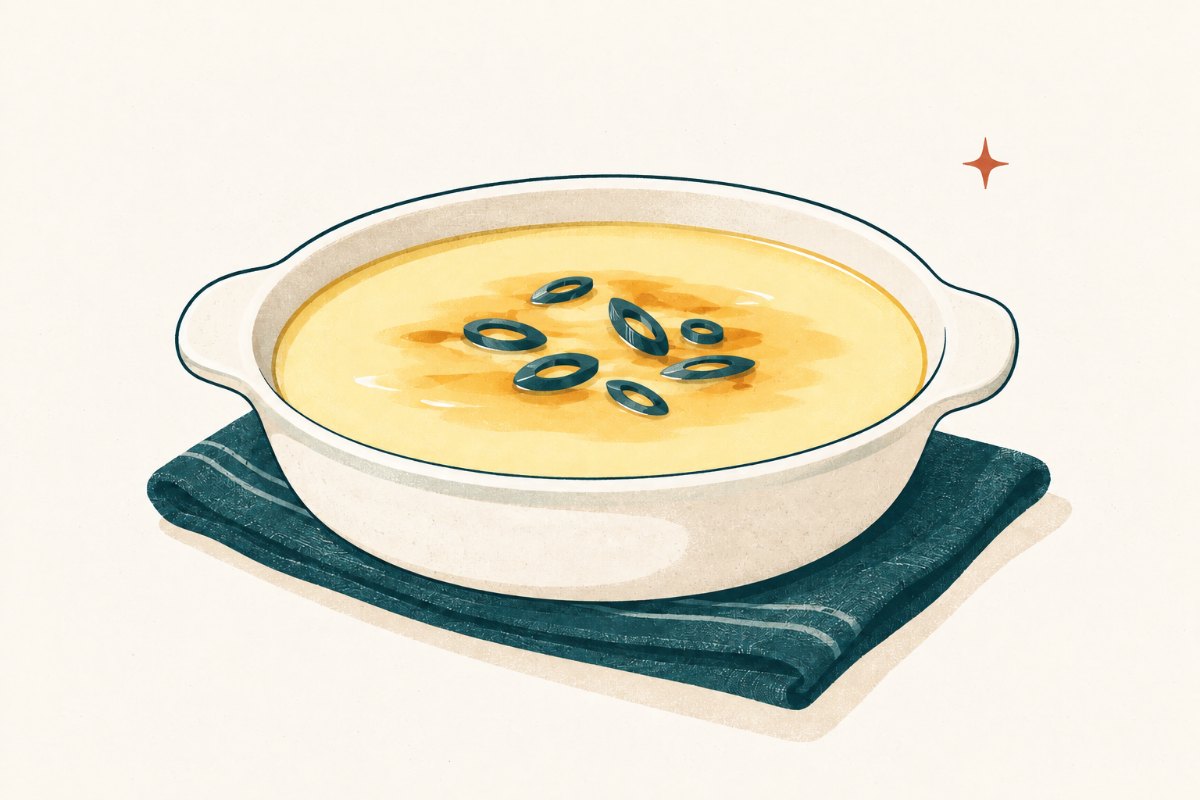
Cantonese steamed egg turns eggs, warm water, and salt into a softly set savoury custard. The ingredient list is short, but the result depends on details that many recipes leave implicit: the liquid ratio, the depth of the dish, the force of the steam, and the point at which the center is safely cooked.
This version makes those decisions visible. Measure the beaten egg, add 1.5 times that volume of warm water, and steam the covered dish gently. You do not need a wok or bamboo steamer—only a lidded pot, a stable rack, and a shallow heatproof dish that fits inside.
Verification note: This is a source-verified adaptation, not a recipe kitchen-tested by Not Hard to Cook. The ratio and method draw from published Cantonese and Chinese steamed egg methods, and the safety temperatures come from current US government guidance.
Why this recipe works
- The ratio follows the egg: Measuring the beaten egg accounts for size variation. The selected 1:1.5 egg-to-water ratio is documented in a Hong Kong government recipe for steamed water egg.
- A shallow dish reduces guesswork: A wider, shallower layer heats more evenly than the same mixture in a deep bowl. Vessel shape and material still affect the exact time.
- Gentle steam protects the texture: A covered dish and steady, moderate steam reduce surface bubbles and keep lid condensation off the custard.
- The thermometer settles doneness: A soft wobble describes texture. Reaching 160°F (71°C) at the center confirms the safe minimum for an egg dish.
Recipe at a glance
| Prep | Cook | Additional | Total | Yield | Difficulty |
|---|---|---|---|---|---|
| 10 minutes | About 12 minutes* | 3 minutes | 25 minutes | 2 side-dish servings | Easy |
*Begin checking at 10 minutes. A deeper or thicker dish may need up to 14 minutes or longer; the center must reach 160°F (71°C).
About Cantonese steamed egg
The Traditional Chinese name used here is 蒸水蛋, romanized in Jyutping as zing1 seoi2 daan2. The phrase appears in the Chinese University of Hong Kong’s Cantonese comparison database, and cookbook author Hetty McKinnon describes the dish in Cantonese as “water egg” in her SBS recipe.
Steamed egg custards are not exclusive to Cantonese cooking. Related dishes use different names, liquid ratios, seasonings, and cooking methods across China. This page presents a plain Cantonese-style water-egg formulation; it does not claim one universal or uniquely authentic version.
Equipment
- Shallow heatproof dish: Use a dish about 8 inches/20 cm wide with at least 2 cups/500 ml capacity. Two shallow ramekins work, but may cook faster.
- Lidded pot or wok: It must hold the dish above the water with the lid fully closed. A metal steamer also works.
- Stable steaming rack: Use a purpose-made rack or heatproof trivet that cannot tip. The water must stay below the serving dish.
- Fine-mesh sieve: Straining removes ropey egg white and much of the foam.
- Thin-probe food thermometer: This is required to verify the safe center temperature without making a large opening in the custard.
- Heatproof plate or foil: Cover the serving dish so condensed water does not drip onto the surface. Make sure the pot lid can still close.
Ingredients
Steamed egg
- 3 large eggs, beaten and measured by volume (about 150 ml/2/3 cup)
- 225 ml (scant 1 cup) warm water, about 100–110°F/38–43°C, or exactly 1.5 times the measured egg volume
- 1/4 teaspoon fine salt
Optional finish
- 1 teaspoon light soy sauce
- 1/2 teaspoon toasted sesame oil
- 1 small scallion, thinly sliced
Substitutions and allergens: Egg is required. Unsalted stock can replace the water, but it changes the plain water-egg flavor and may add sodium or allergens. Light soy sauce contains soy and often wheat; toasted sesame oil contains sesame. Check every product label and account for cross-contact in your own kitchen. No universal gluten-free or allergen-free claim is made.
Mise en place
- Check that the shallow dish, rack, and pot lid fit together before heating the water. Leave enough clearance to lift the hot dish safely.
- Beat the eggs gently, measure their volume, and multiply by 1.5 to find the water volume. For 150 ml egg, use 225 ml water.
- Warm the water to about 100–110°F/38–43°C. It should feel warm, not hot.
- Slice the optional scallion and have the dish cover, sieve, dry oven mitts, and clean thermometer ready before the custard enters the steamer.
How to make Cantonese steamed egg
- Build the steamer. Set a stable rack in a lidded pot or wok. Add enough water to steam for at least 15 minutes without touching the serving dish. Cover and bring the water to a boil over high heat.
- Measure the egg and water. Beat 3 eggs gently until the yolks and whites combine without a cap of foam. Measure the egg volume, multiply it by 1.5, and measure that amount of warm water.
- Mix and strain. Dissolve 1/4 teaspoon salt in the warm water. Stir it into the egg without whipping in extra air. Strain into the shallow dish, skim any remaining bubbles, and cover with a heatproof plate or foil.
- Steam gently. Place the covered dish on the rack, close the pot, and lower the heat to medium-low. The water should make steady steam, not pound the lid with a violent boil. Steam without opening the lid for 10 minutes.
- Verify doneness. Open the lid away from your face. The surface should be set; the center may wobble gently but should show no pool of liquid. Insert a clean thin thermometer probe into the center. If it is below 160°F/71°C, re-cover and steam in 1-minute increments until it reaches that temperature.
- Rest the custard. Turn off the heat, keep the dish covered, and rest for 3 minutes. Lift it out with dry oven mitts. The dish and trapped steam are hot.
- Finish and serve. Remove the cover so condensation runs away from the custard. Add the optional light soy sauce, sesame oil, and scallion. Serve warm.
Critical technique notes
Measure the liquid against the eggs
Published recipes range from roughly 1:1 to nearly 1:2 egg-to-liquid by volume. More liquid generally produces a softer set, but also narrows the margin between soft and unset. This draft selects 1:1.5 as a clear starting point; it is not presented as the only correct Cantonese ratio.
Control depth before chasing the clock
A deep bowl can leave the center cool while the edges tighten. Use the specified shallow dish, and expect ceramic, glass, and metal vessels to heat differently. That is why the method gives a check window and a temperature target instead of promising that every steamer will finish at exactly 12 minutes.
Keep condensation outside the custard
Covering the serving dish blocks droplets from the pot lid. When uncovering, tilt the plate or foil away from the egg so accumulated water does not run back onto the surface.
Treat wobble as a texture cue, not a safety test
A slight, unified wobble suggests a soft set; rippling liquid suggests more time. Neither cue measures temperature. FoodSafety.gov specifies 160°F (71°C) for egg dishes, so use a clean food thermometer at the center.
Troubleshooting
| Problem | Likely cause | Fix now | Prevent next time |
|---|---|---|---|
| Many holes or a puffy surface | Steam was too forceful, or the mixture held foam | Lower the heat; serve if the center has reached 160°F/71°C | Beat gently, strain, skim bubbles, and use steady medium-low steam |
| Center is liquid | Dish is deep, vessel is thick, or steam is too weak | Re-cover and steam in 1-minute increments to 160°F/71°C | Use an 8-inch/20-cm shallow dish and preheat the steamer |
| Edges are firm or rubbery | Custard cooked too hot or too long | There is no full texture recovery; serve with rice | Lower the heat after loading and begin checking at 10 minutes |
| Water sits on the surface | Dish was uncovered or condensation ran inward | Carefully spoon off surface water | Cover the dish and lift the cover so droplets run away |
| Texture is firmer than expected | Too little water for the measured egg volume | Serve as is | Measure the beaten egg and use 1.5 times its volume of water |
Variations
Unsalted-stock version
Replace the warm water with the same volume of warm unsalted chicken or vegetable stock. This makes the custard more savoury but moves it away from the plain water- egg profile. Check stock labels for sodium and allergens, and keep the same 1:1.5 liquid ratio.
Plain finish
Skip the soy sauce, sesame oil, and scallion. The base method and cooking time do not change. Taste before adding more salt at the table.
Do not add raw meat or seafood using this timing. Those versions introduce new thickness and food-safety variables and need separately researched recipes.
Serving suggestions
Serve the steamed egg warm as one shared side with rice and a vegetable dish. The existing steamed rice guide is the most useful accompaniment link, although its legacy title and content still require a separate audit.
Storage and reheating
- Refrigerate: Serve promptly. Refrigerate leftovers in a shallow covered container within 2 hours, or within 1 hour when the room is above 90°F/32°C. Use within 3–4 days, following FDA egg-safety guidance.
- Freeze: Freezing is not recommended here because this exact custard has not been tested after thawing and may release water. No freezer quality window is claimed.
- Reheat: Cover and reheat gently in short intervals or with gentle steam, checking more than one spot until the center reaches 165°F/74°C. Expect a firmer texture than when freshly cooked. The reheating method itself has not been kitchen-tested by Not Hard to Cook.
Frequently asked questions
What is the best water-to-egg ratio for Cantonese steamed egg?
There is no single universal ratio. This recipe uses 1 part beaten egg to 1.5 parts warm water by volume, a ratio documented in a Hong Kong government steamed-water-egg recipe. Other published methods use more or less liquid for softer or firmer results.
Can I make steamed egg without a steamer?
Yes. Put a stable steaming rack in a lidded pot wide enough for the serving dish. Keep the water below the dish, leave space for steam to circulate, and make sure the lid closes. Do not improvise with an unstable support.
Should I cover the egg while it steams?
Yes. A heatproof plate or foil keeps lid condensation off the surface. Keep the cover clear of the custard and remove it so droplets run away from the egg.
How do I know when steamed egg is done?
The surface should be set, with a slight unified wobble and no visible pool of liquid. Then confirm the center has reached 160°F/71°C with a clean food thermometer. Appearance alone is not the safety check.
Can I make it ahead?
You can refrigerate the cooked dish promptly and keep it 3–4 days, but reheating will firm the texture. For the softest result, serve it soon after cooking. Do not leave it at room temperature beyond the FDA limits above.
Recipe card
Cantonese Steamed Egg (蒸水蛋; zing1 seoi2 daan2)
A plain Cantonese-style steamed water egg made with 1.5 parts warm water to 1 part beaten egg by volume. Source-verified; not kitchen-tested by Not Hard to Cook.
- Prep: 10 minutes
- Cook: About 12 minutes; begin checking at 10
- Rest: 3 minutes
- Total: 25 minutes
- Yield: 2 side-dish servings
- Difficulty: Easy
Equipment: 8-inch/20-cm shallow heatproof dish of at least 2-cup/500-ml capacity; lidded pot or wok; stable rack; fine-mesh sieve; heatproof plate or foil; thin-probe instant-read thermometer; dry oven mitts.
Ingredients:
- 3 large eggs, beaten and measured by volume (about 150 ml/2/3 cup)
- 225 ml (scant 1 cup) warm water at 100–110°F/38–43°C, or 1.5 times the egg volume
- 1/4 teaspoon fine salt
- 1 teaspoon light soy sauce, optional
- 1/2 teaspoon toasted sesame oil, optional
- 1 small scallion, thinly sliced, optional
Instructions:
- Set a stable rack in a lidded pot, add water below dish level, and bring to a boil.
- Beat and measure the eggs. Measure 1.5 times that volume of warm water.
- Dissolve salt in the water, stir into the egg, strain into the shallow dish, skim bubbles, and cover the dish.
- Put the dish on the rack, close the pot, reduce to medium-low, and steam 10 minutes.
- Check the center. Continue in 1-minute increments until it reaches 160°F/71°C.
- Turn off the heat and rest, covered, for 3 minutes.
- Lift out safely, uncover away from the custard, add optional finishes, and serve warm.
Storage: Refrigerate within 2 hours (1 hour above 90°F/32°C), use within 3–4 days, and reheat to 165°F/74°C. Freezing is not recommended for texture.
Allergens: Egg. Optional soy sauce may contain soy and wheat; optional sesame oil contains sesame. Check labels and manage cross-contact for your kitchen.
Nutrition information
Nutrition information has not been independently verified and is not provided.