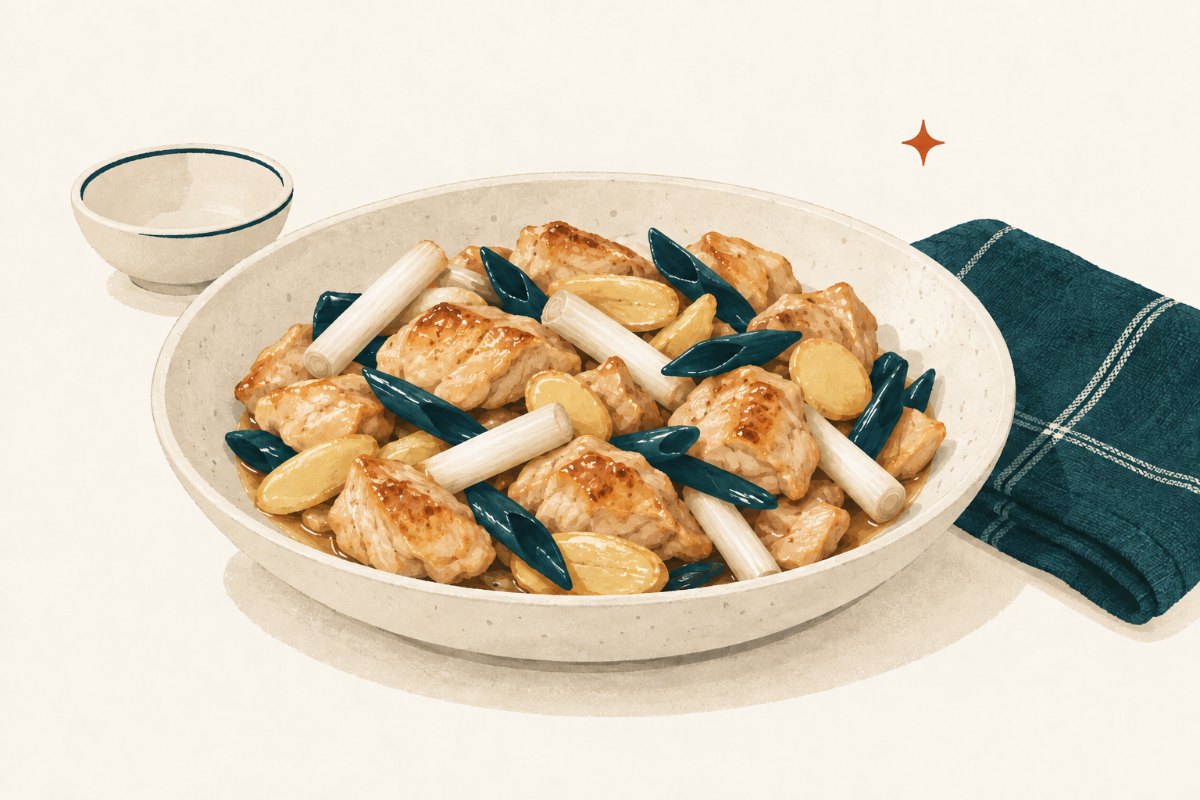
Ginger scallion chicken stir-fry is a savory, aromatic chicken dish with tender ginger slices, distinct scallion pieces, and a light oyster-sauce glaze. This version is built for a 12-inch (30-cm) home skillet rather than a restaurant burner.
The practical difference is batching. One pound of chicken goes into the skillet in two shallow rounds, so it can sizzle instead of sitting in a deep layer of released liquid. The sauce is fully mixed before the burner comes on, and the finished chicken is checked at 165°F (74°C), not judged by color alone.
Verification note: This formula is source-verified, not kitchen-tested by Not Hard to Cook. The dish identity, technique pattern, raw-poultry controls, endpoint, and condiment-label issues were researched. The exact skillet timing, sauce balance, yield, and reheating quality still require a documented test cook.
Why this recipe works
- Even pieces finish together: Keeping each piece around 1 1/2 inches (4 cm) across and no thicker than 1/2 inch (1.25 cm) narrows the doneness gap.
- Two batches preserve the sizzle: About 8 ounces (227 g) per batch keeps the chicken one layer deep in a 12-inch (30-cm) skillet.
- Scallions have two jobs: The whites soften with the ginger and garlic; the greens go in at the end so they remain bright and recognizable.
- The sauce has a defined endpoint: It should be glossy and lightly cling to the chicken, not form a deep pool or a sticky paste.
- Temperature settles doneness: Several of the largest pieces must reach 165°F (74°C), even if smaller pieces look opaque earlier.
Recipe at a glance
| Prep | Cook | Additional | Total | Yield | Difficulty |
|---|---|---|---|---|---|
| 20 minutes | 20 minutes | 15 minutes marinating | 55 minutes | 4 rice-bowl servings | Intermediate |
Pan and batch rule: Use a 12-inch (30-cm) skillet and cook the chicken in two roughly 8-ounce (227-g) batches. Allergen notes: soy, sesame, commonly wheat, and oyster/mollusc are relevant; Shaoxing wine and sauce formulas vary by brand.
What this dish is—and is not
School of Wok describes spring onion and ginger chicken as a classic Cantonese takeaway-style stir-fry: marinated thigh pieces are seared, then coated with oyster sauce, rice wine, and stock. Bee Yinn Low also documents ginger-scallion chicken as a restaurant stir-fry associated with Cantonese-style wok cooking. Those sources support the context, not a claim that this is the one definitive formula.
This recipe is not white-cut chicken (白切雞). In that Cantonese preparation, the chicken is poached and commonly served with a ginger-scallion oil or dipping sauce. The Woks of Life’s poached version illustrates the difference: the chicken is poached, cooled, shredded, and topped with a separately cooked dressing. Here, raw bite-size chicken is marinated and stir-fried directly in a skillet.
The English phrase “ginger scallion chicken” can point to either family of dishes online. “Stir-fry” in this page title is therefore functional, not decorative.
Equipment
- 12-inch (30-cm) nonstick or well-seasoned skillet: The diameter and two- batch rule work together. A stable 14-inch (35-cm) flat-bottom wok is a useful alternative, but keep the batches on a typical home burner.
- Thin-probe instant-read thermometer: Small chicken pieces need a probe that can reach the center from the side. A thick dial stem is not suitable here.
- Clean landing plate: Both seared batches wait on this plate. Never return cooked chicken to the raw-chicken bowl.
- Two bowls: Use a medium bowl for raw chicken and a separate small bowl for the clean sauce. The sauce must never be mixed in the raw bowl.
- Spatula and clean serving dish: Stage both before heat so there is no search for equipment while the ginger or starch-thickened sauce is cooking.
Ingredients
Chicken and marinade
- 1 pound (454 g) raw boneless, skinless chicken thighs, trimmed and cut into roughly 1 1/2-inch (4-cm) pieces no thicker than 1/2 inch (1.25 cm)
- 1 tablespoon (15 ml) light soy sauce
- 1 tablespoon (15 ml) Shaoxing wine
- 1 tablespoon (8 g) cornstarch
- 1 teaspoon (5 ml) toasted sesame oil
Aromatics, sauce, and pan oil
- 1 1/2 ounces (40 g) fresh ginger, peeled and cut into thin 1/16-inch (1.5-mm) coins
- 6 medium scallions, white and pale-green parts cut into 2-inch (5-cm) lengths; dark-green parts sliced 1/4 inch (6 mm) thick on the diagonal
- 2 large garlic cloves, about 2 teaspoons (6 g), thinly sliced
- 1 tablespoon (15 ml) oyster sauce
- 3 tablespoons (45 ml) water, plus up to 2 teaspoons (10 ml) more only if needed
- 1 tablespoon (15 ml) Shaoxing wine
- 1 teaspoon (3 g) cornstarch
- 1/2 teaspoon (2 g) granulated sugar
- 1/8 teaspoon (0.25 g) ground white pepper
- 2 tablespoons (30 ml) neutral cooking oil, divided into three 2-teaspoon (10-ml) portions
Substitutions and allergens: Soy sauce contains soy and commonly wheat. Toasted sesame oil contains sesame. Oyster sauce contains oyster/mollusc and commonly contains wheat; its US regulatory category is not the same as crustacean shellfish, but that does not make it safe for an oyster-allergic person. Some Shaoxing cooking wines contain wheat or added salt. Read every label and consider kitchen cross-contact. A mushroom-based vegetarian stir-fry sauce can replace oyster sauce one-for-one, producing mushroom-forward umami without oyster character; it may still contain soy or wheat, and the chicken recipe is not vegetarian. Dry sherry can replace Shaoxing wine at the same volume, with a different aroma. No universal gluten-free or allergen-free version is claimed.
Mise en place
- Set a raw-poultry zone. Keep the chicken, raw bowl, knife, and board away from the clean sauce bowl, scallion greens, landing plate, thermometer handle, and serving dish. Do not wash the chicken; splashing can spread contamination.
- Fix the chicken size. Trim large fat pockets. Cut pieces about 1 1/2 inches (4 cm) across and no thicker than 1/2 inch (1.25 cm). Very small scraps will cook faster; group them so they can be removed first if necessary.
- Marinate cold. Mix the chicken with its soy sauce, wine, cornstarch, and sesame oil until no dry starch remains. Cover and refrigerate for 15 minutes.
- Clean before continuing. Wash hands, then clean and sanitize the knife, board, counter, faucet, and any handles touched during raw preparation.
- Stage the aromatics. Keep ginger coins, garlic, scallion whites, and scallion greens in separate piles because they enter the skillet at different times.
- Mix a clean sauce. Whisk oyster sauce, water, wine, cornstarch, sugar, and white pepper in a bowl that never held chicken. Cornstarch settles, so plan to whisk again immediately before pouring.
- Place the clean landing plate and thermometer beside the stove. Once the first batch starts, every transition happens quickly.
How to make ginger scallion chicken stir-fry
- Preheat the skillet. Heat the dry 12-inch (30-cm) skillet over medium-high for about 2 minutes. Add 2 teaspoons (10 ml) oil and swirl. Look for a shimmer, not smoke. If it smokes, remove the pan briefly and lower the burner.
- Sear the first batch. Stir the marinated chicken and add half—about 8 ounces (227 g)—in one layer with small gaps. Leave it for 90 seconds, until an active sizzle has returned and the underside has pale-golden patches. Stir-fry for 1–2 minutes more. Most surfaces should look opaque, but the centers may still be under 165°F (74°C). Move the batch to the clean landing plate.
- Sear the second batch. Add another 2 teaspoons (10 ml) oil, let it shimmer, and repeat: 90 seconds undisturbed, then 1–2 minutes stir-frying. Move this batch to the clean plate. Discard the raw bowl and its residue; it is not sauce.
- Bloom the aromatics. Reduce the heat to medium and add the final 2 teaspoons (10 ml) oil. Spread in the ginger and cook 45–60 seconds, stirring once, until fragrant and lightly golden only at the edges. Add garlic and scallion whites; stir for 30–45 seconds, until aromatic and bright, not brown.
- Start the glaze. Re-whisk the sauce and pour it into the skillet. Stir for 20–30 seconds. It should bubble and change from slightly cloudy to more translucent.
- Return the chicken. Add both batches and any juices from the clean plate. Toss over medium to medium-high for 2–4 minutes. The glaze is ready when it is glossy and lightly coats the pieces rather than sitting as a deep puddle. A spatula drawn across the pan should leave a trail that closes slowly.
- Correct only if needed. If the glaze turns pasty before the chicken is done, add water 1 teaspoon at a time, up to 2 teaspoons. If it remains watery, keep it bubbling for 20–30 seconds before deciding whether it needs longer.
- Verify doneness and finish. Lift several of the largest pieces with a clean utensil and insert a clean thin probe through the side into each center. Continue tossing and checking until every sampled large piece reaches 165°F (74°C). Add scallion greens and toss for 20–30 seconds, just until glossy and slightly softened. Transfer immediately so the residual skillet heat does not keep tightening the sauce.
Critical technique notes
One layer matters more than the word “high”
A restaurant wok and a home skillet do not recover heat the same way. Turning a home burner to its maximum cannot compensate for a pile of cold, damp chicken. The specified batch should sit one layer deep with small gaps. After it enters, listen for the sizzle to return before stirring. A little released moisture is normal; a spreading pool and gray surfaces mean the pan is overcrowded or the chicken is too wet. Make the next batch smaller rather than raising the flame until the oil smokes.
Ginger gets a head start; garlic does not
Thin ginger coins benefit from 45–60 seconds in oil. Sliced garlic can go bitter much faster, so it joins with the scallion whites only after the ginger smells fragrant. Dark-brown ginger edges or browned garlic are stop signs: lower the heat and add the sauce promptly.
“Glossy” is a visual cue, not a starch quantity contest
Oyster sauce already has body, and both the marinade and sauce contain starch. The correct finish is a thin, shiny film around each piece. It is not a spoonable gravy, but it also should not pull into strings or clumps. Because condiment brands differ, use the two-teaspoon water allowance as a controlled correction.
Check several pieces at 165°F
FoodSafety.gov sets 165°F (74°C) for poultry. Thigh pieces are irregular, so checking one small piece is weak evidence. Check several of the largest. USDA thermometer guidance supports side entry for thin foods so the sensing area reaches the center. The timer and opaque color tell you when to start checking; the thermometer decides.
Troubleshooting
| Problem | Likely cause | Fix now | Prevent next time |
|---|---|---|---|
| Chicken is pale and releasing liquid | Batch is too large, pan did not preheat, or pieces were wet | Stop stirring and let moisture evaporate; do not add sauce yet | Keep each batch near 8 ounces/227 g, use one layer, and preheat until oil shimmers |
| Chicken sticks | Pan seasoning is weak, oil was not shimmering, or the first side was moved too early | Lower heat slightly and wait for the surface to release; do not scrape aggressively | Use nonstick or a well-seasoned pan and leave the first side 90 seconds |
| Ginger or garlic is browning fast | Pan remained too hot after chicken | Lower to medium and add the sauce as soon as the aromatics smell fragrant | Reduce heat before the last oil and keep garlic out until the ginger has had its head start |
| Sauce is too salty | Condiment or cooking-wine brand has more salt | Add 1 teaspoon water, toss, and reassess; serve with plain rice | Use measured sauce, no added salt, and check labels for salted cooking wine |
| Glaze is pasty | Starch thickened before chicken finished, or liquid evaporated too far | Add water 1 teaspoon at a time, up to 2 teaspoons | Re-whisk immediately before pouring and stop when the sauce lightly clings |
| Sauce is thin and cloudy | Cornstarch was not re-whisked or sauce has not boiled | Keep it bubbling 20–30 seconds while tossing | Whisk from the bottom just before pouring |
| Some pieces are under 165°F | Pieces were uneven or the sampled piece was too small | Keep tossing over medium heat and recheck the largest pieces | Enforce the 1/2-inch/1.25-cm maximum thickness and check several large pieces |
Variations
Chicken breast
Use 1 pound (454 g) boneless skinless breast cut across the grain into pieces no thicker than 1/2 inch (1.25 cm). Keep the same marinade and two-batch loading. Begin thermometer checks sooner during the final toss because breast is leaner, but do not stop below 165°F (74°C). Expect a firmer, less rich result.
Mushroom-sauce version
Replace the tablespoon of oyster sauce with the same amount of mushroom-based vegetarian stir-fry sauce. The glaze will have mushroom-forward umami rather than oyster character and can differ in sweetness, color, and salt. Check the chosen label for soy, wheat, sesame, mollusc ingredients, and cross-contact. This swap does not make a chicken dish vegetarian.
Serving suggestions
Serve the four portions over plain steamed rice so the concentrated ginger and light glaze have a neutral base. A simply cooked green vegetable—such as bok choy, choy sum, or gai lan—adds contrast without asking another sweet sauce to compete with the chicken.
Storage and reheating
- Refrigerate: Move leftovers to shallow covered containers within 2 hours, or within 1 hour when the surrounding temperature is above 90°F (32°C). Keep at 40°F (4°C) or below and use within 3–4 days.
- Freeze: No freezer recommendation is made because this exact sauce and scallion finish have not been assessed after freezing and thawing.
- Reheat: Add 1–2 teaspoons water per serving, cover, and reheat gently in a skillet or microwave. Stir for even heating and verify the chicken reaches 165°F (74°C). Expect softer scallions and a firmer chicken texture.
Frequently asked questions
Is ginger scallion chicken the same as white-cut chicken?
No. This recipe stir-fries raw, bite-size chicken and glazes it in the skillet. White-cut chicken is poached and is commonly served with a separate ginger- scallion oil or dipping sauce. Similar English naming does not make the cooking methods interchangeable.
Do I need a wok?
No. The canonical method is written for a 12-inch (30-cm) nonstick or well- seasoned skillet and therefore supports a future No Wok tag once that archive is useful. A 14-inch (35-cm) flat-bottom wok works, but a home burner still benefits from the same two chicken batches.
Can I use chicken breast?
Yes, if it is cut no thicker than 1/2 inch (1.25 cm). It is leaner and can feel firmer, so begin checking sooner during the final toss while still reaching 165°F (74°C).
What should the sauce look like?
It should be translucent, glossy, and lightly cling to each piece. It should not sit as a deep puddle or pull into a sticky paste. Correct a too-thick glaze with water one teaspoon at a time, up to two teaspoons.
Can I leave out oyster sauce?
For a similar sauce body, replace it one-for-one with a mushroom-based vegetarian stir-fry sauce. The result will taste more mushroom-forward and lack oyster character. Check labels: these sauces commonly contain soy and may contain wheat.
Is opaque chicken safely cooked?
Color is not enough. Check several of the largest pieces from the side with a thin probe and continue cooking until each sampled center reaches 165°F (74°C).
Recipe card
Ginger Scallion Chicken Stir-Fry
Boneless chicken thigh pieces are marinated, seared in two shallow skillet batches, and finished with ginger, garlic, scallions, and a light oyster-sauce glaze before being checked at 165°F (74°C).
Alternate name: Cantonese-Style Spring Onion and Ginger Chicken
Prep: 20 minutes
Cook: 20 minutes
Additional: 15 minutes refrigerated marinating
Total: 55 minutes
Yield: 4 rice-bowl servings
Difficulty: Intermediate
Equipment
- 12-inch (30-cm) nonstick or well-seasoned skillet
- Thin-probe instant-read thermometer
- Clean landing plate or rimmed quarter sheet pan
- One medium raw-chicken bowl and one small clean sauce bowl
Chicken and marinade
- 1 pound (454 g) raw boneless, skinless chicken thighs, trimmed and cut into roughly 1 1/2-inch (4-cm) pieces no thicker than 1/2 inch (1.25 cm)
- 1 tablespoon (15 ml) light soy sauce
- 1 tablespoon (15 ml) Shaoxing wine
- 1 tablespoon (8 g) cornstarch
- 1 teaspoon (5 ml) toasted sesame oil
Aromatics, sauce, and pan oil
- 1 1/2 ounces (40 g) fresh ginger, peeled and cut into thin 1/16-inch (1.5-mm) coins
- 6 medium scallions, white and pale-green parts cut into 2-inch (5-cm) lengths and dark-green parts sliced 1/4 inch (6 mm) thick on the diagonal
- 2 large garlic cloves, about 2 teaspoons (6 g), thinly sliced
- 1 tablespoon (15 ml) oyster sauce
- 3 tablespoons (45 ml) water, plus up to 2 teaspoons (10 ml) more only if needed
- 1 tablespoon (15 ml) Shaoxing wine
- 1 teaspoon (3 g) cornstarch
- 1/2 teaspoon (2 g) granulated sugar
- 1/8 teaspoon (0.25 g) ground white pepper
- 2 tablespoons (30 ml) neutral cooking oil, divided into three 2-teaspoon (10-ml) portions
Preparation and refrigerated marinade
- Cut and marinate the chicken. Do not wash the raw chicken. On a raw- poultry work surface, trim and cut it to the specified size. Mix in the raw bowl with light soy, 1 tablespoon Shaoxing wine, 1 tablespoon cornstarch, and sesame oil until no dry starch remains. Cover and refrigerate 15 minutes.
- Clean up and stage. Wash hands; clean and sanitize the raw-poultry knife, board, counter, and handles. Slice ginger and garlic; divide scallion whites and greens. Set out a clean landing plate, spatula, thermometer, and serving dish.
- Mix the clean sauce. In the clean small bowl, whisk oyster sauce, 3 tablespoons water, 1 tablespoon Shaoxing wine, 1 teaspoon cornstarch, sugar, and white pepper. Keep up to 2 teaspoons extra water nearby.
Two-batch stir-fry and finish
- Preheat the skillet. Heat the dry 12-inch skillet over medium-high for about 2 minutes. Add 2 teaspoons oil; it should shimmer, not smoke.
- Sear the first batch. Add half the chicken, about 8 ounces (227 g), in one layer. Leave 90 seconds, then stir-fry 1–2 minutes until mostly opaque with pale-golden patches. Transfer to the clean landing plate.
- Sear the second batch. Add 2 teaspoons oil and repeat. Transfer to the clean plate. Discard the raw bowl and residue; do not use it as sauce.
- Bloom the aromatics. Reduce heat to medium and add the final 2 teaspoons oil. Cook ginger 45–60 seconds until fragrant and lightly golden at the edges. Add garlic and scallion whites; stir-fry 30–45 seconds.
- Glaze the chicken. Re-whisk and pour in the sauce. Stir 20–30 seconds until bubbling and beginning to turn translucent. Return chicken and clean-plate juices. Toss 2–4 minutes until the sauce is glossy and lightly clings. If it turns pasty, add extra water 1 teaspoon at a time, up to 2 teaspoons.
- Verify and finish. Probe several of the largest pieces from the side and continue cooking until every sampled center reaches 165°F (74°C). Add scallion greens, toss 20–30 seconds, and transfer immediately to the serving dish.
Storage: Refrigerate promptly in shallow covered containers and use within 3–4 days. Reheat with a little water until the chicken reaches 165°F (74°C).
Allergen note: Contains soy, sesame, and oyster/mollusc; wheat is commonly present in soy sauce and oyster sauce, and may occur in Shaoxing wine. Check all labels.
Verification: Source-verified, not kitchen-tested by Not Hard to Cook.
Nutrition information
Nutrition information has not been independently verified and is not provided.