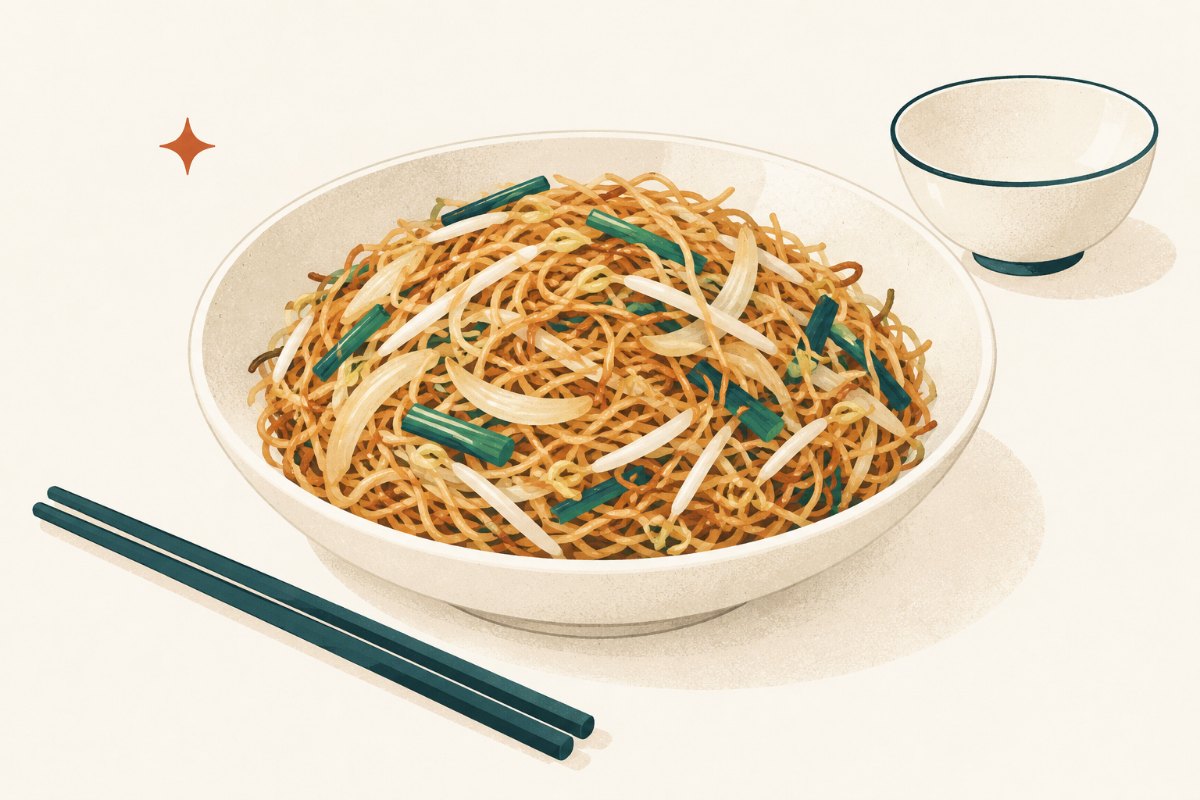
These Cantonese soy sauce pan-fried noodles are a small-batch adaptation of si yau wong chow mein: thin egg noodles tossed with soy sauce, bean sprouts, onion, and scallions. The result should be dry rather than saucy, with separate strands and lightly toasted patches.
The method fits a 12-inch skillet as well as a wok. Its main control is not a restaurant burner; it is keeping the noodles dry, the batch small, and the sauce ready before the pan gets hot.
Verification note: This formulation is source-verified but has not been kitchen-tested by a named human for Not Hard to Cook. The times and sensory cues are conservative editorial targets that should be confirmed in a documented test cook before publication.
Why this recipe works
- A small batch protects pan heat: Eight ounces of fresh noodles fit a 12-inch skillet without packing it into a steamy mound.
- The drying pause controls texture: A thorough drain and 5-minute surface dry remove the water most likely to turn a stir-fry soft.
- The sauce is measured before cooking: Light and dark soy, water, sugar, sesame oil, and white pepper can coat the noodles quickly without forming a gravy.
- A wok is optional: A broad skillet gives the noodles enough contact with the hot surface, even though it cannot guarantee restaurant wok hei.
Recipe at a glance
| Prep | Cook | Additional | Total | Yield | Difficulty |
|---|---|---|---|---|---|
| 15 minutes | 15 minutes | None | 30 minutes | 2 main servings or 3 side servings | Easy |
Expected allergens: wheat, egg, soy, and sesame under the specified ingredients. Brands and shared-equipment statements vary, so check every package if an allergy is relevant.
About Cantonese soy sauce pan-fried noodles
The name shown here, 豉油皇炒麵, is often translated as “supreme soy sauce fried noodles” and rendered informally in English as si yau wong chow mein. The variant 豉油王炒麵 also appears in current Cantonese recipe sources. That spelling variation does not justify presenting one version as the only correct form.
Michelin Guide Hong Kong describes the dish with chives, scallion, and bean sprouts and notes its place beside congee. Made With Lau and The Woks of Life document the soy-forward noodle style in a dim sum and Cantonese cooking context. Those sources support a strong Hong Kong association, but not a claim that this exact formula is traditional or historically definitive.
The English phrase “Cantonese pan-fried noodles” can also mean a crisp noodle cake served under meat, seafood, vegetables, and gravy. This is not that dish. Here, the thin noodles are toasted in patches, loosened, and tossed directly with a small quantity of soy-based seasoning.
Equipment
- 14-inch flat-bottomed wok: Its sloped sides make tossing easier. A 12-inch well-seasoned cast-iron skillet is the practical alternative. If you use nonstick, follow the pan maker’s heat and empty-preheating limits.
- 4-quart saucepan: Use it to loosen the fresh noodles briefly. Any pot that lets the strands move without crowding will work.
- Colander: It must hold the thin noodles while allowing a forceful drain.
- Tongs or long cooking chopsticks: These lift and separate strands. Two flexible spatulas work if tongs are unavailable.
Ingredients
Sauce
- 2 teaspoons (10 mL) light soy sauce
- 1 teaspoon (5 mL) Chinese dark soy sauce
- 1 tablespoon (15 mL) water
- 1 teaspoon (4 g) granulated sugar
- 1/2 teaspoon (2.5 mL) toasted sesame oil
- 1/8 teaspoon ground white pepper, optional
Noodles and vegetables
- 8 ounces (225 g) fresh thin Hong Kong-style pan-fry egg noodles
- 3.5 ounces (100 g) mung bean sprouts, rinsed and well drained
- 2 ounces (60 g, about 1/2 small) yellow onion, cut into 1/8-inch (3 mm) slices
- 2 scallions, cut into 2-inch (5 cm) lengths, whites and greens separated
- 2 tablespoons (30 mL) neutral high-heat oil, such as canola, grapeseed, or refined avocado oil, divided
Substitutions and allergens: The intended noodles are thin fresh egg noodles labeled “Hong Kong-style pan-fry noodles” or “chow mein noodles.” Thick lo mein noodles make a softer, heavier dish, while wonton soup noodles are a different product. Conventional egg noodles and soy sauces commonly contain wheat; the noodles contain egg, soy sauce contains soy, and toasted sesame oil contains sesame. FDA guidance supports checking each label because formulas and cross-contact statements vary. Omitting sesame oil removes its aroma but is more reliable than suggesting an unverified substitute.
For more help choosing light and dark soy sauce, review the site’s Cantonese sauce guide. That legacy page is live, but its title and body still require the planned source audit before this link is approved for publication.
Mise en place
- Mix all six sauce ingredients in a small bowl. Stir until most of the sugar dissolves.
- Slice the onion to an even 1/8 inch (3 mm). Cut the scallions and keep the pale sections separate from the greens.
- Rinse and drain the bean sprouts. Discard any that are slimy, darkened, or sour-smelling.
- Set a tray or clean towel beside the colander. The loosened noodles need a 5-minute surface-drying pause before they enter the pan.
- Place the oil, vegetables, sauce, tongs, and serving plate within reach. Once frying starts, there is no useful pause for measuring.
How to make Cantonese soy sauce pan-fried noodles
- Loosen and dry the noodles. Bring a 4-quart saucepan of water to a boil. Add the fresh noodles and cook only until the strands separate, 30 to 60 seconds, unless the package directs otherwise. Drain immediately, rinse briefly under cold water, and shake the colander firmly. Spread the noodles on the tray or towel for 5 minutes. They should feel cool and damp but should not drip when lifted.
- Toast the first side. Heat a dry 14-inch flat-bottomed wok or 12-inch skillet over medium-high heat for 2 minutes. For nonstick, follow the pan maker’s heat and empty-preheating limits instead. Add 1 tablespoon oil and swirl to coat. Spread the noodles in one loose layer, then leave them undisturbed for 2 to 3 minutes, until the underside has dry, pale-golden patches.
- Toast the second side. Turn the noodles in sections rather than forcing one perfect flip. Drizzle 1 teaspoon oil around the edge and cook for 2 minutes more. Transfer the noodles to a plate. They should remain flexible, with scattered toasted patches rather than a rigid noodle cake.
- Cook the aromatics and sprouts. Return the pan to medium-high heat. Add the remaining 2 teaspoons oil, onion, and scallion whites. Stir-fry for 45 to 60 seconds, until the onion edges soften and the scallions sizzle. Add the drained bean sprouts and toss for 1 to 2 minutes, until they are steaming hot and beginning to turn translucent.
- Coat the noodles. Return the noodles to the pan. Stir the sauce again, then pour it over the noodles rather than into an empty patch of hot pan. Toss continuously for 1 to 2 minutes, lifting and separating any clumps.
- Finish and serve. Add the scallion greens and toss for 30 to 60 seconds. Stop when the strands are evenly light brown, no liquid pools in the pan, and the sprouts are hot and tender-crisp. Serve immediately.
Critical technique notes
Dry noodles before chasing higher heat
The reviewed Cantonese recipe sources use slightly different hydration methods, but they agree on the failure point: waterlogged noodles. A hotter pan cannot undo excess surface water. Drain first, spread the noodles out, and wait until they no longer drip.
Keep the batch small
Restaurant burners and seasoned woks recover heat quickly. Most home stoves do not. A two-serving batch gives more noodle surface contact and makes recovery after adding vegetables and sauce easier.
If the noodles steam without taking on any dry patches, stop tossing for 30 seconds at a time. If liquid pools after the sauce goes in, spread the noodles out and let the moisture evaporate before the final toss.
Light soy seasons; dark soy colors
Light soy sauce supplies most of the salt and soy flavor. Dark soy deepens the color and changes the flavor profile, but brands differ. Replacing the dark soy with more light soy makes a paler and potentially saltier dish, so do not add extra salt before tasting.
Treat sprouts as a safety-sensitive ingredient
Bean sprouts are commonly cooked briefly for a crisp texture, but the FDA warns that raw or lightly cooked sprouts can carry harmful bacteria. People at higher risk for foodborne illness should avoid raw or lightly cooked sprouts. For those diners, cook the sprouts thoroughly before combining them with the noodles, or omit them; do not rely on a short tender-crisp toss.
Troubleshooting
| Problem | Likely cause | Fix now | Prevent next time |
|---|---|---|---|
| Noodles are wet and soft | They were overcooked or not drained long enough | Spread them out in the hot pan and pause between tosses until visible moisture evaporates | Cook only until the strands separate, drain forcefully, and surface-dry for 5 minutes |
| Noodles stick in one mass | Pan or noodles were too cool; layer was too thick | Divide the mass with tongs and turn small sections instead of forcing one flip | Preheat the dry pan for 2 minutes and keep the batch at 8 ounces |
| Color is patchy | Sauce was not remixed or the noodles stayed clumped | Lower the heat slightly and toss while separating strands | Stir the sauce immediately before adding it and pour over the noodles |
| Dish tastes too salty | Soy-sauce sodium was higher than expected | Add a small handful of hot, unseasoned noodles or sprouts if available; do not add plain water unless it can evaporate | Use the listed amounts, skip added salt, and compare labels |
| Sprouts are limp | They cooked too long or sat in pooled liquid | Serve promptly; texture cannot be fully restored | Drain well and add them late, while following the safety note for higher-risk diners |
Variations
Chinese chive variation
Replace the scallion greens with 1 ounce (30 g) Chinese chives cut into 2-inch (5 cm) lengths. Add them with the scallion greens in the final minute. The flavor will be more chive-forward, matching an allium documented by Michelin Guide Hong Kong and TVB/myTV SUPER.
Dried Hong Kong-style pan-fry noodles
Use a package specifically labeled for Hong Kong-style pan-frying or chow mein. Cook only to the package’s lower timing limit, rinse, drain, and spread the noodles until the surface is no longer wet. Because dry products vary in bundle size and hydration, do not assume 8 ounces dry equals the fresh-noodle yield or timing above.
Adding beef, chicken, or shrimp creates a different chow mein formulation. It should become a separate recipe with its own cooking method and safety controls, not a one-line variation under the supreme soy sauce name.
Serving suggestions
Serve the noodles immediately, either as two light mains or three side portions. A steamed egg or simply cooked green vegetable would balance the dry noodle texture without covering it in sauce.
The existing quick Cantonese soups and noodle dishes page is the current live bridge to the noodle cluster, pending its planned content audit.
Storage and reheating
- Refrigerate: Move leftovers to a shallow covered container and refrigerate within 2 hours of cooking, or within 1 hour when the surrounding temperature is above 90°F (32°C). Use within 3 to 4 days.
- Freeze: Freezing is not recommended for texture because the sprouts and noodles are likely to soften. No quality window is assigned without a test.
- Reheat: Heat a skillet over medium, add the noodles with 1 to 2 teaspoons water, cover for 1 minute, then uncover and toss until the food reaches 165°F (74°C). A microwave also works when the noodles are covered, rotated, and checked in several places.
These limits follow current USDA leftovers guidance, not a shelf-life test of this recipe.
Frequently asked questions
Are soy sauce chow mein and Cantonese pan-fried noodles the same dish?
Not always. Soy sauce chow mein or si yau wong chow mein usually points to the dry, soy-seasoned stir-fry described here. “Cantonese pan-fried noodles” can also mean a crisp noodle base topped with a separate gravy, meat or seafood, and vegetables. Read the ingredient list and method rather than relying on the English title alone.
What noodles should I buy?
Look in the refrigerated section of an Asian market for thin fresh egg noodles labeled “Hong Kong-style pan-fry noodles” or “chow mein noodles.” Check whether the package says unsteamed, steamed, ready to cook, or ready to fry, then use its direction if it conflicts with the 30-to-60-second loosening step.
Can I make this without a wok?
Yes. Use a 12-inch well-seasoned cast-iron skillet, or use nonstick within the manufacturer’s heat and preheating limits. Keep the batch to 8 ounces of fresh noodles. The skillet can produce toasted patches and a dry stir-fry, but the recipe does not promise restaurant wok hei.
Can I leave out dark soy sauce?
Yes. Replace it with 1 teaspoon light soy sauce, then expect a paler and possibly saltier result. Do not add extra salt until the finished noodles have been tasted.
Can I loosen the noodles ahead of time?
The noodles can be loosened, drained, and held briefly while the vegetables are cut and the sauce is mixed. Long make-ahead storage has not been tested for this formulation, so the canonical method keeps loosening and frying in the same 30-minute session.
Recipe card
Cantonese Soy Sauce Pan-Fried Noodles
A two-serving home-stove adaptation of Hong Kong-style supreme soy sauce chow mein, with thin egg noodles, bean sprouts, onion, scallions, and a light soy-sauce coating.
| Prep | Cook | Total | Yield | Difficulty |
|---|---|---|---|---|
| 15 minutes | 15 minutes | 30 minutes | 2 main-dish servings or 3 side-dish servings | Easy |
Equipment: 14-inch flat-bottomed wok or 12-inch skillet; 4-quart saucepan; colander; tongs or long cooking chopsticks.
Sauce
- 2 teaspoons (10 mL) light soy sauce
- 1 teaspoon (5 mL) Chinese dark soy sauce
- 1 tablespoon (15 mL) water
- 1 teaspoon (4 g) granulated sugar
- 1/2 teaspoon (2.5 mL) toasted sesame oil
- 1/8 teaspoon ground white pepper, optional
Noodles and vegetables
- 8 ounces (225 g) fresh thin Hong Kong-style pan-fry egg noodles
- 3.5 ounces (100 g) mung bean sprouts, rinsed and well drained
- 2 ounces (60 g, about 1/2 small) yellow onion, thinly sliced
- 2 scallions, cut into 2-inch (5 cm) lengths, whites and greens separated
- 2 tablespoons (30 mL) neutral high-heat oil, divided
Instructions
- Mix the sauce. Stir both soy sauces, water, sugar, sesame oil, and white pepper in a small bowl until the sugar mostly dissolves.
- Loosen and dry the noodles. Boil the fresh noodles only until the strands separate, 30 to 60 seconds, unless the package directs otherwise. Drain, rinse briefly under cold water, shake thoroughly, and spread on a tray or towel for 5 minutes, until damp but no longer dripping.
- Toast the noodles. Preheat the dry wok or skillet over medium-high for 2 minutes; for nonstick, follow the pan maker’s heat and empty-preheating limits instead. Add 1 tablespoon oil and spread the noodles in one layer. Cook undisturbed for 2 to 3 minutes. Turn in sections, add 1 teaspoon oil, and cook 2 minutes more, until flexible with pale-golden toasted patches. Move the noodles to a plate.
- Cook the vegetables. Add the remaining 2 teaspoons oil, onion, and scallion whites. Stir-fry for 45 to 60 seconds. Add the bean sprouts and toss for 1 to 2 minutes, until steaming hot and beginning to turn translucent.
- Season and finish. Return the noodles. Remix and add the sauce, then toss for 1 to 2 minutes. Add scallion greens and toss 30 to 60 seconds more, until the noodles are evenly light brown, the pan has no pooled liquid, and the sprouts are hot and tender-crisp. Serve immediately.
Allergen note: Contains wheat, egg, soy, and sesame under the specified ingredients. Check every package and cross-contact statement.
Storage: Refrigerate within 2 hours and use within 3 to 4 days. Reheat to 165°F (74°C). Freezing is not recommended for texture.
Verification: Source-verified, not kitchen-tested by a named human for Not Hard to Cook. No rating or nutrition estimate is supplied.
Nutrition information
Nutrition information has not been independently verified and is not provided.