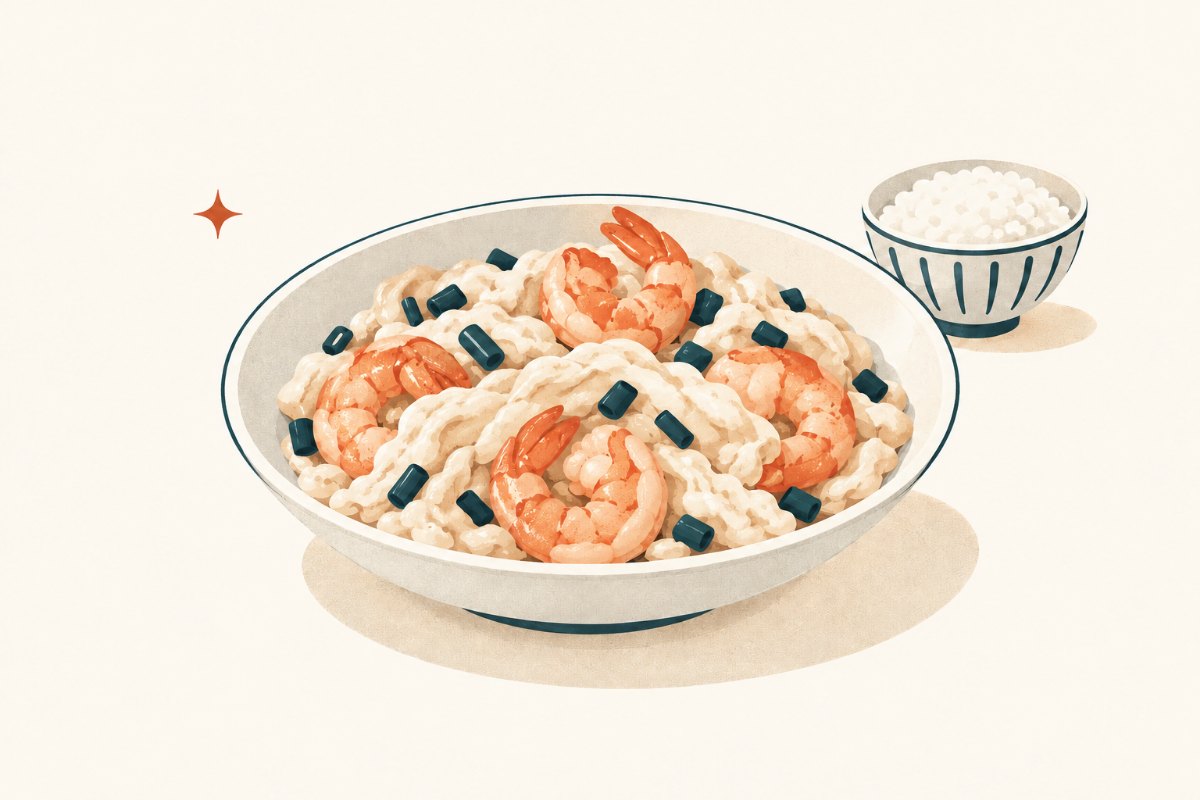
Cantonese shrimp and scrambled eggs pair curled shrimp with broad sheets of soft-set egg rather than small, dry curds. This version uses a 12-inch nonstick skillet, so a seasoned wok is optional.
The shrimp cook first and move to a clean plate. The eggs then set in wide layers before the shrimp return for the finish. Temperature checks make the separate seafood and egg endpoints explicit instead of asking color or carryover heat to carry the whole safety decision.
Scope and verification:
滑蛋蝦仁is well supported as a Cantonese and Hong Kong home-style dish. This exact formula is source-verified but has not been kitchen-tested by Not Hard to Cook. The 30-minute total is an editorial estimate that starts with fully thawed shrimp, not a measured speed claim.
Why this recipe works
- Separate shrimp cooking gives it a clear endpoint: Each shrimp can become opaque and pearly and reach 145°F/63°C before the fast egg stage begins.
- A small slurry supports broad, tender folds: Cornstarch and water change how the egg mixture sets, but they do not replace thorough cooking.
- Push, tilt, and fold preserve larger sheets: Constant stirring would break the eggs into smaller curds. Pauses let liquid egg reach the pan.
- Immediate plating limits carryover: A wide skillet retains enough heat to keep cooking the eggs after the burner is off.
Recipe at a glance
| Prep | Refrigerated rest | Cook | Total | Yield | Difficulty | Pan |
|---|---|---|---|---|---|---|
| About 10 minutes | 10 minutes | About 10 minutes | Estimated 30 minutes | 4 shared-dish servings with rice | Intermediate | 12-inch/30-cm skillet |
The clock assumes peeled, deveined, fully thawed shrimp. Refrigerator thawing overnight is outside that estimate. The 30-minute category fits the disclosed recipe clock, but the public time tag should wait for a named human test.
About Cantonese shrimp and scrambled eggs
The traditional written name 滑蛋蝦仁 appears as 滑蛋虾仁 in simplified characters. Its Jyutping is waat6 daan2 haa1 jan4: Jyut Dictionary records waat6 daan2 for 滑蛋 and haa1 jan4 for the shelled-shrimp term 蝦仁.
Made With Lau and The Woks of Life both document the dish and a Cantonese fold-and-stack approach to the eggs. Hong Kong’s Centre for Food Safety also publishes controls for shrimp scrambled eggs. The combined evidence supports a Cantonese label without proving a single city, inventor, date, or fixed ratio.
You may also see 蝦仁炒蛋 or simplified 虾仁炒蛋, literally framing the dish as shrimp fried with egg. Published methods overlap, but not every version uses a slurry or the same soft-fold target. This page uses 滑蛋蝦仁 because the smooth, layered egg treatment is central to the selected method.
This is not egg foo young, which is formed more like an omelet or patty and may be served with gravy.
Equipment
- 12-inch/30-cm nonstick skillet: It gives 225 g shrimp room for one layer and provides a broad surface for folding. A seasoned 14-inch/36-cm wok works, but it heats and cools differently.
- Wide flexible spatula: A broad edge lifts egg sheets without cutting them into tiny curds.
- Thin-probe instant-read thermometer: Use it for the small shrimp and in several of the thickest egg folds.
- Raw-shrimp bowl and clean holding plate: Keep them distinct. Cooked shrimp must never return to a bowl that held raw seafood unless it has been washed.
- Medium egg bowl and small slurry bowl: Mix the slurry separately so no dry starch pockets enter the eggs.
Ingredients
For the shrimp
- 225 g (8 oz) peeled and deveined medium shrimp, fully thawed if frozen and patted thoroughly dry
- 1/4 teaspoon fine salt
- 1/8 teaspoon ground white pepper
- 1/2 teaspoon (1.5 g) cornstarch
- 1 teaspoon (5 ml) neutral cooking oil
For the eggs
- 5 large eggs
- 1/2 teaspoon fine salt
- 1/8 teaspoon ground white pepper
- 1 teaspoon (5 ml) toasted sesame oil
- 1 teaspoon (3 g) cornstarch
- 1 tablespoon (15 ml) cold water
For cooking and finishing
- 1 large scallion, thinly sliced, pale and green parts separated
- 3 tablespoons (45 ml) neutral cooking oil, divided
Substitutions and allergens: This recipe contains crustacean shellfish, egg, and sesame. Replace the sesame oil with 1 teaspoon neutral oil only to omit that ingredient; the result loses toasted aroma and is not universally allergen-free. A pinch of finely ground black pepper can replace white pepper, with a different aroma and visible flecks. Large shrimp can be cut into 1-inch/2.5-cm pieces before seasoning. Check packaged starch, spices, and oils for household-specific cross-contact.
Mise en place
- Start with fully thawed shrimp. The FDA recommends refrigerator thawing overnight. For a faster method, seal the shrimp in a leakproof bag and submerge it in cold water, or microwave-defrost only when cooking immediately.
- Drain and press the shrimp dry between clean paper towels. Season them in a raw-seafood bowl and refrigerate for 10 minutes.
- Slice the scallion and separate the pale and green pieces. Mix the slurry in its own small bowl.
- Set out the egg bowl, clean shrimp plate, spatula, and clean thermometer. Wash hands and clean boards, dishes, and counters with hot, soapy water after contact with raw shrimp.
How to make Cantonese shrimp and scrambled eggs
- Dry and season the shrimp. Mix the dry shrimp with 1/4 teaspoon salt, 1/8 teaspoon white pepper, 1/2 teaspoon cornstarch, and 1 teaspoon neutral oil. Cover and refrigerate for 10 minutes.
- Mix the eggs. Stir 1 teaspoon cornstarch with 1 tablespoon cold water. Beat the eggs with 1/2 teaspoon salt, 1/8 teaspoon white pepper, and 1 teaspoon sesame oil for about 30 seconds, until homogeneous and bubbly. Re-stir and add the slurry immediately before cooking.
- Cook the shrimp. Heat the 12-inch skillet over medium-high for 1 to 2 minutes. Add 1 tablespoon cooking oil. When it shimmers without smoking, spread in the shrimp. Cook 2 to 3 minutes, turning once, until every piece is opaque and pearly and the thickest reach 145°F/63°C. Move them to the clean plate.
- Start broad egg folds. Reduce the burner to medium. Add the remaining 2 tablespoons cooking oil and pale scallion pieces. Stir 10 seconds, then add the eggs. Wait about 10 seconds. Push set egg toward the center and tilt the pan so liquid egg fills the open space. Continue for 45 to 75 seconds, until broad sheets form with wet egg between them and no browning.
- Return the shrimp. Lower the heat to medium-low. Add the shrimp and its clean-plate juices. Lift and fold for 30 to 90 seconds, pausing so uncooked egg reaches the pan. If the bottom colors, pull the skillet off the heat for 10 seconds before continuing.
- Verify and plate. Check thick egg folds in two or three places. At 160°F/71°C, with no loose raw egg, remove the pan from heat. Fold in the scallion greens once and slide everything onto a plate immediately.
Critical technique notes
Dry the shrimp before the pan
Surface water cools the skillet and creates steam. Pat the thawed shrimp dry before adding the measured seasoning. Cornstarch is a surface treatment in this method, not permission to skip drying and not a food-safety control.
Keep cooked shrimp away from raw-seafood contact
Some published versions return partly cooked shrimp to a marinating bowl. This adaptation cooks the shrimp fully, then uses a clean plate. The FDA advises cleaning hands, utensils, dishes, and work surfaces between raw seafood and cooked or ready-to-eat food.
Fold broad sheets instead of stirring tiny curds
Let a thin base set, then push it inward and tilt fresh egg onto the exposed pan. Repeat with short pauses. A chopping or whisking motion breaks the sheets; leaving the pan untouched too long browns the base before the upper egg sets.
Soft-set is a texture target, not a raw center
FoodSafety.gov lists 160°F/71°C for egg dishes, while FDA describes safe shrimp as opaque and pearly and gives 145°F/63°C for most seafood. Hong Kong CFS publishes a stricter shrimp-and-egg control of 75°C/167°F for 30 seconds. Readers following that system should use its higher endpoint. This page does not recommend runny egg under either standard.
Troubleshooting
| Problem | Likely cause | Fix now | Prevent next time |
|---|---|---|---|
| Water pools around the eggs | Shrimp were wet or crowded | Move solids to the clean plate and evaporate the liquid briefly before recombining | Thaw completely, drain, dry, and use a 12-inch pan |
| Shrimp are rubbery | They stayed in the first stage too long or returned too early | Plate immediately once the eggs are safe; the texture cannot be reversed | Stop the first stage at 145°F/63°C and add shrimp only near the finish |
| Eggs form tiny dry curds | They were stirred continuously | Stop stirring and use slower lift-and-fold motions | Wait for thin sheets, then push and tilt |
| Egg base browns | Pan or oil was too hot | Pull the skillet off heat for 10 seconds and reduce the burner | Use shimmering, non-smoking oil and medium heat for eggs |
| Dry starch spots appear | Slurry was not dissolved or settled before use | Remove any obvious lump and fold gently | Mix separately, re-stir, then add immediately |
| Eggs are below 160°F/71°C | Folds are too thick or the heat was reduced too early | Continue on medium-low, pausing between folds, then recheck several spots | Keep the thermometer ready and do not depend on carryover heat |
Variations
Seasoned-wok method
Use a properly seasoned 14-inch/36-cm wok. Preheat it over medium heat until a drop of water evaporates promptly, dry the surface, then add oil. Follow the same shrimp and egg temperatures, but expect faster edge setting. Lift the wok off the burner briefly if the egg colors. This is an equipment adaptation, not a home-stove wok-hei claim.
Without sesame oil
Replace the 1 teaspoon sesame oil in the eggs with 1 teaspoon neutral oil. The folding method and safety endpoints stay unchanged, while the toasted aroma is removed. The dish still contains crustacean shellfish and egg, and packaged ingredients still require label review.
Serving suggestions
Serve the shrimp and eggs immediately with steamed rice and a vegetable side. The existing steamed rice method and beginner stir-fry guide are candidate prerequisites, but both sitemap-only legacy destinations require a content and canonical audit before these links are retained publicly.
Storage and reheating
- Refrigerate: Move leftovers to a shallow covered container within 2 hours, or within 1 hour above 90°F/32°C. Use within 3–4 days, following FDA egg guidance.
- Freeze: Not recommended for this untested adaptation. Freezing and thawing can release water and toughen both shrimp and egg; no site-specific quality window is claimed.
- Reheat: Cover and heat gently, stirring or rotating for even heating, until several checked spots reach 165°F/74°C. Expect firmer eggs and shrimp.
Frequently asked questions
Do I need a wok?
No. A 12-inch nonstick skillet provides the specified surface area and makes the broad folds easier for a beginner. A seasoned wok works, but its heat response may shorten the egg stage.
Can I use frozen shrimp?
Yes. The main sources use or support frozen shrimp. Thaw it in the refrigerator, or use the FDA’s sealed cold-water method and cook immediately. The 30-minute recipe clock begins after the shrimp are fully thawed.
Why cook the shrimp before the eggs?
The separate stage lets you confirm that every piece is opaque and pearly and reaches 145°F/63°C. It also prevents wet raw shrimp from releasing its liquid directly into the eggs.
What does the cornstarch slurry do?
It is a documented technique for encouraging tender egg folds. Re-stir it before use because starch settles. It does not make undercooked egg safe, and the exact effect in this formula still needs a named test cook.
Should the eggs still look runny when served?
No. During folding, wet egg remains between the set sheets. At service, no loose raw egg should remain and the thickest folds should reach 160°F/71°C. Readers following Hong Kong CFS guidance should use 75°C/167°F for 30 seconds.
Is this the same as egg foo young?
No. Egg foo young is formed as an omelet-like patty and may come with gravy. 滑蛋蝦仁 uses soft, layered scrambled-egg folds with shrimp distributed through them.
How long can raw shrimp stay refrigerated?
USDA FSIS advises cooking or freezing raw fish and shellfish within 1–2 refrigerated days. Follow the package date when it is earlier, and discard shrimp with sour, rancid, strongly fishy, or ammonia odors.
Recipe card
Cantonese Shrimp and Scrambled Eggs (滑蛋蝦仁; waat6 daan2 haa1 jan4)
Fully cooked shrimp folded through broad, soft-set eggs with scallion. This is a source-verified Cantonese home-style adaptation and has not been kitchen-tested by Not Hard to Cook.
- Prep: About 10 minutes
- Refrigerated rest: 10 minutes
- Cook: About 10 minutes
- Total: Estimated 30 minutes, starting with fully thawed shrimp
- Yield: 4 shared-dish servings with rice
- Difficulty: Intermediate
- Pan: 12-inch/30-cm nonstick skillet or seasoned 14-inch/36-cm wok
Ingredients:
- 225 g (8 oz) peeled and deveined medium shrimp, fully thawed if frozen and patted thoroughly dry
- 1/4 teaspoon fine salt, for the shrimp
- 1/8 teaspoon ground white pepper, for the shrimp
- 1/2 teaspoon (1.5 g) cornstarch, for the shrimp
- 1 teaspoon (5 ml) neutral cooking oil, for the shrimp seasoning
- 5 large eggs
- 1/2 teaspoon fine salt, for the eggs
- 1/8 teaspoon ground white pepper, for the eggs
- 1 teaspoon (5 ml) toasted sesame oil
- 1 teaspoon (3 g) cornstarch, for the egg slurry
- 1 tablespoon (15 ml) cold water, for the egg slurry
- 1 large scallion, thinly sliced, pale and green parts separated
- 3 tablespoons (45 ml) neutral cooking oil, divided
Instructions:
- Dry and season the shrimp. Put 225 g (8 oz) fully thawed shrimp on clean paper towels and press them dry. In a raw-seafood bowl, mix the shrimp with 1/4 teaspoon salt, 1/8 teaspoon white pepper, 1/2 teaspoon cornstarch, and 1 teaspoon neutral oil until evenly coated. Cover and refrigerate for 10 minutes. Wash hands and clean any surface or utensil that touched raw shrimp with hot, soapy water.
- Mix the eggs. Slice the scallion and separate the pale and green parts. In a small bowl, stir 1 teaspoon cornstarch with 1 tablespoon cold water until smooth. In a clean medium bowl, beat 5 eggs with 1/2 teaspoon salt, 1/8 teaspoon white pepper, and 1 teaspoon sesame oil for about 30 seconds, until the whites and yolks are homogeneous and bubbles cover the surface. Re-stir the slurry and beat it into the eggs immediately before cooking.
- Cook the shrimp. Heat a 12-inch/30-cm nonstick skillet over medium-high for 1 to 2 minutes. Add 1 tablespoon of the cooking oil; when it flows easily and shimmers without smoking, spread the shrimp in one layer. Cook for 2 to 3 minutes, turning once, until every piece is opaque and pearly and the thickest pieces reach 145°F/63°C. Transfer the shrimp to a clean plate, never to the raw-shrimp bowl.
- Start broad egg folds. Reduce the burner to medium. Add the remaining 2 tablespoons cooking oil and the pale scallion pieces. Stir for 10 seconds, until fragrant, then pour in the egg mixture. Leave it undisturbed for about 10 seconds. Push the set egg from the edge toward the center with a wide spatula while tilting the pan so liquid egg runs into the open space. Continue for 45 to 75 seconds; broad sheets should form, with wet egg still visible between them and no browning.
- Return the shrimp. Lower the heat to medium-low. Add the cooked shrimp and any juices from the clean plate. Lift and fold the egg over the shrimp for 30 to 90 seconds, pausing between folds so the remaining liquid egg contacts the pan. Do not chop or stir continuously; if the bottom colors, pull the pan off the heat for 10 seconds before continuing.
- Verify and plate. Check the thickest egg folds in two or three places with a clean thin-probe thermometer. When they reach 160°F/71°C and no loose raw egg remains, remove the skillet from the heat immediately. Fold in the scallion greens once, then slide the shrimp and eggs onto a serving plate so carryover heat does not keep cooking them.
Storage: Refrigerate within 2 hours, or 1 hour above 90°F/32°C. Use within 3–4 days and reheat to 165°F/74°C. Freezing is not recommended for quality.
Allergens: Crustacean shellfish, egg, and sesame. Check all packaged ingredients for household-specific cross-contact.
Nutrition information
Nutrition information has not been independently verified and is not provided.