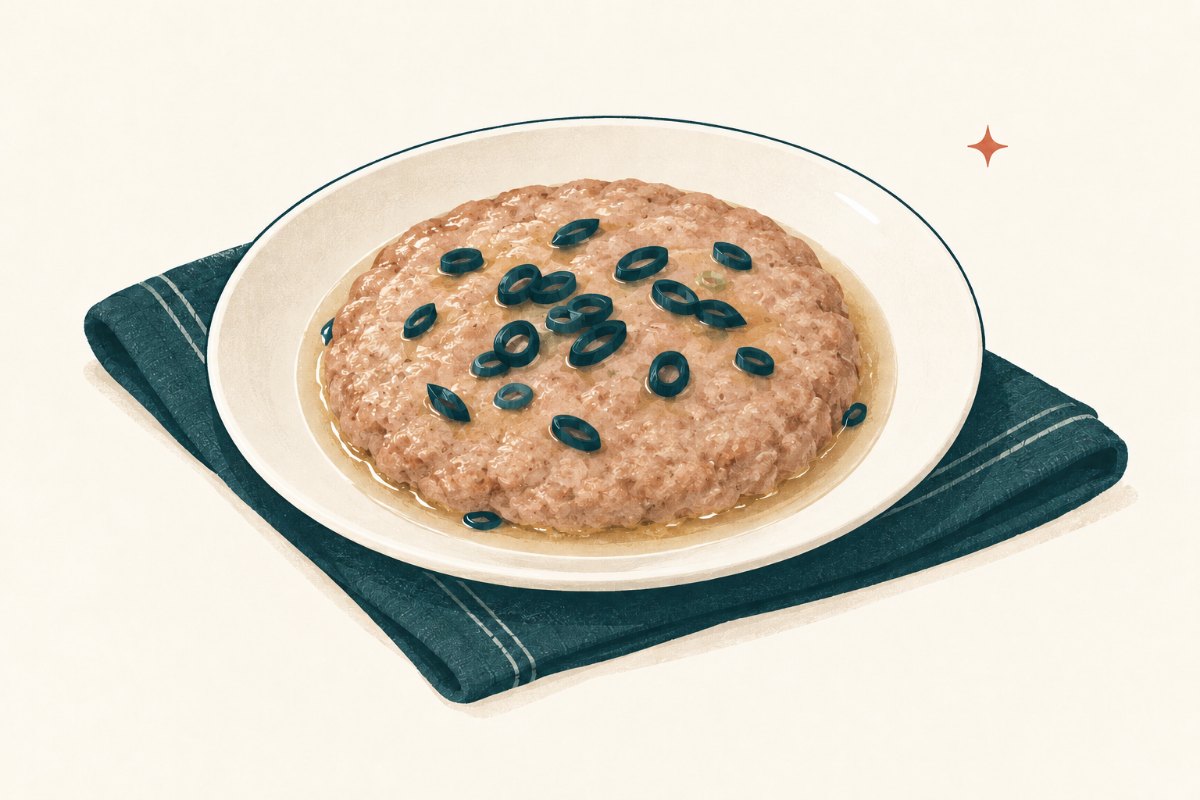
Cantonese steamed pork patty is a shallow layer of seasoned ground pork cooked on a plate over steam. This source-informed version removes the uncertainty that many short recipes leave behind: it specifies the plate, pot, water level, patty diameter and depth, and a 160°F/71°C center.
The recipe is designed for an ordinary covered pot or deep skillet, so a bamboo steamer is not required. The estimated clock is 55 minutes, including a 15-minute refrigerated rest and steamer setup—not a hidden “quick” claim.
Verification note: Not Hard to Cook has source-checked the dish context, method, and current food-safety guidance, but a named human has not kitchen-tested this exact formulation. Use the measurements and thermometer endpoint as written, and treat the texture and time range as awaiting a documented test.
Why This Recipe Works
- The geometry is fixed: A 7-inch/18-cm round that is 5/8 inch/1.5 cm deep makes the temperature check more reproducible than “spread on a plate.”
- Steam begins hot: The plate enters only after the water reaches a full boil, following specialist guidance to avoid a cold-steam start.
- Water and starch are controlled: Two tablespoons of water and one level tablespoon of cornstarch are incorporated before a refrigerated rest; the draft does not rely on an egg or preserved ingredient to bind or season the pork.
- Safety is measured: A thin probe enters from the side to check the center for 160°F/71°C. Color, firmness, clear juices, and a timer are not used as substitutes.
- Related versions stay distinct: Water chestnut, dried squid, salted fish, preserved vegetables, and salted egg are explained without pretending that they can be dropped into this formula unchanged.
Recipe at a Glance
| Prep | Cook | Additional | Total | Yield | Difficulty |
|---|---|---|---|---|---|
| About 15 minutes | About 25 minutes | 15-minute refrigerated rest | Estimated 55 minutes | 4 shared-dish servings with rice and another dish | Intermediate |
The cook estimate includes bringing the water to a boil, shaping, 13–18 minutes of steaming/checking, and moving the hot plate safely. Pot, burner, starting-water temperature, and actual pork depth can change the elapsed time; the center temperature decides when the patty is done.
About Cantonese Steamed Pork Patty
The traditional characters are 蒸肉餅, with simplified 蒸肉饼. A transparent Jyutping reading is zing1 juk6 beng2. Jyut Dictionary defines 肉餅 as a steamed minced-meat patty and documents named Cantonese examples made with preserved vegetables or dried squid.
Multiple independent sources place the broader dish family in Cantonese or Hong Kong home cooking. Made With Lau describes steamed pork patty as a Cantonese home-cooking staple, while Hong Kong’s Centre for Food Safety publishes a water-chestnut-and-dried-squid version as a common home-style dish. That is enough to use “Cantonese” carefully; it is not evidence of one inventor, date, place of creation, or universal formula.
This page is a deliberately plain adaptation. Made With Lau’s 榨菜蒸豬肉餅 contains pickled mustard tuber and water chestnut. Hong Kong CFS publishes versions with water chestnut alone or with dried squid. Woks of Life publishes a salted-duck-egg patty. Those are related dishes, not evidence that every ingredient belongs in one base recipe.
Equipment
- Covered wide pot or deep skillet, 12 inches/30 cm: It needs at least 10 inches/25 cm of clear internal diameter so the 9-inch plate sits level without touching the walls. A wok or dedicated metal steamer is suitable only when the same plate/rack/lid clearances are met.
- Stable heat-safe rack, about 1.5–2 inches/4–5 cm high: It keeps the plate above the water. Use a purpose-made rack or trivet rated for cookware; do not balance the plate on an unstable improvised object.
- Rimmed heatproof plate, 9 inches/23 cm: The rim holds cooking juices. If using another dish, retain the 7-inch/18-cm by 5/8-inch/1.5-cm pork geometry and make sure the lid closes.
- Thin-probe instant-read thermometer: A tip-sensitive probe is needed to read the center of a shallow patty. A thick dial stem may not place its sensing area correctly.
- Medium mixing bowl and flexible spatula: Mix the raw pork in its own bowl rather than on the plate that will later be handled as ready-to-eat tableware.
- Dry oven mitts and a dry heatproof trivet: Steam and the hot plate can burn. Set the landing place beside the stove before cooking.
Ingredients
Pork patty
- 12 ounces (340 g) ground pork labeled 80% lean/20% fat, raw weight and kept cold
- 2 medium scallions, white and pale-green parts finely chopped and dark-green parts thinly sliced, kept separate
- 1 teaspoon (about 5 g) finely grated peeled fresh ginger
- 1 tablespoon (15 ml) light soy sauce
- 2 tablespoons (30 ml) cold water
- 1 level tablespoon (8 g) cornstarch
- 1 teaspoon (5 ml) toasted sesame oil
- 1 teaspoon (4 g) granulated sugar
- 1/8 teaspoon ground white pepper
- 1 teaspoon (5 ml) neutral cooking oil, for the plate
For steaming
- Water to reach 1–1 1/2 inches (2.5–4 cm) deep in the pot, always below the plate
Substitutions and allergens: This recipe contains soy and sesame; conventional light soy sauce commonly contains wheat. Check every label and your kitchen’s cross-contact risks. Use the same weight of 85% lean/15% fat ground pork if necessary, but expect a potentially firmer, less rich result; the substitution has not been kitchen-tested here. Reduced-sodium soy sauce can replace light soy in the same amount for a milder result. Tamari varies in salt and is gluten-free only when its label and handling support that claim. Omit sesame oil rather than replacing it with another strong oil. No fresh-egg, salted-egg, water-chestnut, preserved-vegetable, or dried-seafood substitution is built into this formula.
Mise en Place
- Confirm that the ground pork has stayed at 40°F/4°C or below. USDA refrigeration guidance says raw ground meat should be used or frozen within 1–2 days. FDA home-safety guidance says not to rinse raw meat.
- Chop the scallions and grate the ginger before opening the pork. Keep the dark-green garnish in a clean container away from the raw-meat work area.
- Measure the soy, cold water, cornstarch, sesame oil, sugar, and pepper. Set out a clean thermometer and a place to clean its probe between checks.
- Dry-fit the rack and empty plate in the cold pot. Confirm the plate is level, does not touch the water or walls, and leaves enough clearance for the lid to close.
- Set dry mitts and a dry heatproof trivet beside the stove. Make sure children, pets, loose sleeves, and pan handles are out of the route between pot and trivet.
How to Make Cantonese Steamed Pork Patty
- Prepare safely. Keep the pork refrigerated until needed and do not rinse it. Chop the scallions and grate the ginger on a clean board before opening the pork, keeping the dark-green scallion slices separate for garnish. Wash hands, tools, and work surfaces with hot soapy water after contact with raw pork, and keep the clean garnish away from the raw-meat area.
- Mix and refrigerate. In a medium bowl, combine the cold pork, chopped scallion whites and pale greens, ginger, light soy sauce, cold water, cornstarch, sesame oil, sugar, and white pepper. Fold and stir firmly in one direction for about 60–90 seconds, until the water is absorbed and the mixture looks evenly seasoned and tacky; do not continue beating after it becomes cohesive. Cover and refrigerate for 15 minutes.
- Build and preheat the steamer. Set a stable 1.5–2-inch/4–5-cm heat-safe rack inside a covered 12-inch/30-cm wide pot or deep skillet. Add 1–1 1/2 inches/2.5–4 cm water, keeping the level below the plate. Dry-fit the empty 9-inch/23-cm plate so it sits level with clearance and the lid closes, then remove the plate. Cover and bring the water to a full boil over high heat, allowing up to 7 minutes.
- Shape an even patty. Coat the 9-inch/23-cm plate with 1 teaspoon neutral oil. Scrape the pork mixture onto the center and use the spatula to spread it into an even 7-inch/18-cm round, 5/8 inch/1.5 cm deep at both center and edge. Smooth the surface gently without packing it hard, and wash the spatula or place it with the other raw-meat utensils.
- Steam and verify the center. When the water is boiling steadily, use dry mitts to place the plate on the rack. Cover, reduce the heat only enough to maintain strong steady steam, and steam for 13 minutes. Open the lid away from your face. Insert a clean thin-probe thermometer horizontally from the edge into the geometric center, avoiding the hot plate. If the center is below 160°F/71°C, cover and steam in 1-minute increments, cleaning the probe between checks, until the center reaches 160°F/71°C; expect about 13–18 minutes for the specified depth, but temperature decides. Add boiling water down the side of the pot only if the pan threatens to run dry, never over the food or onto hot dry cookware.
- Remove the plate safely. Turn off the burner. Open the lid away from your face and wait several seconds for the first rush of steam to clear. Using dry mitts or a plate lifter together with dry mitts, move the plate level to a dry heatproof trivet. Leave the clear cooking juices on the plate and scatter the reserved clean scallion greens over the patty.
- Serve hot. Cut or spoon the patty into 4 shared-dish portions and serve hot with rice and another dish. Use a clean serving utensil, and refrigerate leftovers within 2 hours of cooking, or within 1 hour when the ambient temperature is above 90°F/32°C.
Critical Technique Notes
Treat 80/20 as this formula, not a rule
Specialist sources agree that some pork fat supports the intended texture, but they do not agree on a single number. Published recommendations range from fatty shoulder to 70% lean and half-fat/half-lean. This adaptation chooses labeled 80/20 ground pork because it is a clear, purchasable specification; it does not redefine the traditional dish. If the package gives no fat percentage, ask the butcher rather than assuming.
Stop mixing when the pork is cohesive
One-direction mixing helps the seasonings and water distribute through the pork. The target is a tacky, cohesive mixture with no visible water at the bottom of the bowl. More mixing is not automatically better: specialist sources warn that overworking can make the patty dense. The 60–90-second range is a draft control, so record the actual texture and time during a named test.
Depth matters more than plate diameter alone
A mound at the center can remain cooler after the thin edges are done. Measure the 5/8-inch/1.5-cm depth at the center and near the edge; do not make a thick dome. If the pork will not fit at that depth, use a broader heatproof plate that still clears the pot, or cook a smaller batch with its own validated timing. Do not simply accept a thicker layer and reuse this range.
Start over boiling water and maintain steam
Put the filled plate into the pot only after the water is at a full boil. Once covered, lower the burner only enough to prevent violent rattling while preserving a strong, steady supply of steam. A quiet pot with no steam escaping may have dropped below the intended heat; restore the boil and rely on the thermometer rather than guessing how much time was lost.
Insert the thermometer from the side
USDA food-thermometer guidance says to insert the probe from the side of thin patties so its sensing area reaches the center and lists 160°F/71°C for ground meat. Aim horizontally for the geometric center and avoid scraping the plate, which can give a misleading surface reading and damage the probe. Clean the probe between checks. Brown color, clear juice, spring, and a 13-minute timer do not prove safety.
Plan the plate removal before cooking
Steam burns and a plate carrying hot juices is awkward. Keep the landing trivet close, open the lid away from your face, pause for the first plume to clear, and keep the plate level. Wet towels conduct heat and should not replace dry mitts.
Troubleshooting
| Problem | Likely cause | Fix now | Prevent next time |
|---|---|---|---|
| Center is below 160°F/71°C at 13 minutes | Pot, burner, starting water, pork temperature, or depth differed | Re-cover and steam in 1-minute increments; clean and reinsert the probe from the side | Measure 5/8-inch depth, preheat to a full boil, and use the same pot/plate geometry |
| Edges are firm before the center is safe | Center was domed or the patty is thicker than specified | Continue steaming until the center reaches 160°F/71°C; serve the safe result even if the edges are firmer | Spread to the same depth at center and edge |
| Liquid sits in the mixing bowl | Water was added too quickly or mixing stopped before absorption | Fold only until absorbed; if it will not absorb, do not add extra starch beyond the formula | Use cold pork, level the starch, and add the measured water while mixing |
| Patty is dense or rubbery | Mixture was beaten long after it became tacky, packed hard, or overcooked | Slice thinly and serve with its cooking juices; do not dilute a cooked patty | Stop at cohesive/tacky, smooth gently, and check temperature early |
| Patty is firmer or less rich than expected | Pork was leaner than the specified 80/20 or lost moisture through extra cooking | Spoon the plate juices over each portion | Buy labeled 80/20 pork and use the thermometer endpoint |
| Pot is nearly dry | Too little starting water, excessive burner heat, or poor lid fit | If water remains, add boiling water carefully down the pot wall without splashing the food; if dry, turn off heat and move the pot only when safe | Start with 1–1 1/2 inches water and a fitted lid; check before the plate enters |
| Water touches the plate | Rack is too short or water level is too high | Turn off heat and correct the setup once safe; do not continue with a floating or unstable plate | Dry-fit the rack, plate, water level, and lid while the pot is cold |
Variations
Use 85/15 ground pork
Replace the 12 ounces/340 g of 80/20 ground pork with the same weight of ground pork labeled 85% lean/15% fat. Keep the water, starch, seasonings, 7-inch/18-cm diameter, 5/8-inch/1.5-cm depth, steam method, and 160°F/71°C endpoint unchanged. The result may be firmer and less rich. This variation is source-informed but not kitchen-tested, so do not reduce the water or shorten the safety check without a documented comparison.
Related dishes, not plug-in variations
- Water chestnut and dried squid: Hong Kong CFS publishes
Steamed Pork Patty with Dried Squid and Water Chestnuts, which requires soaking and chopping dried squid and uses its own ratio and high-heat process. It introduces a mollusc allergen and cannot be reduced to “add some squid.” - Water chestnut without seafood: A separate CFS control example combines 300 g minced pork with six water chestnuts and has its own seasoning and 15-minute steam. Water chestnut changes both moisture and texture.
- Pickled mustard tuber and water chestnut: Made With Lau’s
榨菜蒸豬肉餅includes both. The preserved vegetable changes salinity and the seasoning balance. - Salted duck egg: Woks of Life’s
鹹蛋蒸肉餅formulation uses raw salted duck egg, a longer marinade, different seasonings, a longer steam, and a covered rest. It adds egg and possibly other allergens. Fresh chicken egg is not a direct substitute for salted duck egg white or yolk. - Salted fish and other dried seafood: These versions add fish or mollusc allergens, concentrated salt, and ingredient-specific preparation. They deserve separate, validated recipes.
Serving Suggestions
Four portions assume this is a shared dish served with rice and at least one vegetable or another protein. Spoon some of the clear cooking juices over the rice rather than discarding them.
Storage and Reheating
- Refrigerate: Following FDA prompt-chilling guidance, transfer leftovers to a clean shallow covered container and refrigerate within 2 hours of cooking, or within 1 hour above 90°F/32°C. Keep the refrigerator at 40°F/4°C or below and use within 3–4 days under USDA storage guidance. Do not store the hot plate where its heat or shape prevents rapid chilling.
- Freeze: Cooked ground-pork dishes can be frozen for safety, but this exact patty’s thawed texture and a useful quality window have not been assessed. Freeze promptly in small airtight portions only if needed; thaw in the refrigerator, not on the counter.
- Reheat: Add a teaspoon of water around one refrigerated portion, cover, and heat until the center reaches the FoodSafety.gov leftover endpoint of 165°F/74°C. In a steamer, begin with an already-hot setup and check early; in a microwave, cover with a vent, rotate if the oven lacks a turntable, allow standing time, and check more than one spot. Timing depends on portion size and appliance, so temperature decides.
Frequently Asked Questions
Is steamed pork patty Cantonese?
The dish family is strongly documented in Cantonese and Hong Kong home-cooking sources, so the label is supportable with limits. It does not mean this site’s exact formula is ancient, universal, or the only correct version. This page is a plain adaptation of a varied home dish.
What do 蒸肉餅 and zing1 juk6 beng2 mean?
蒸肉餅 is the traditional-character name; simplified Chinese is 蒸肉饼. zing1 juk6 beng2 is the Jyutping reading used here. In this context, it describes a steamed minced-meat patty. Named versions often add the preserved vegetable or seafood to the title.
Do I need a bamboo steamer?
No. The specified 12-inch/30-cm pot or deep skillet, stable rack, and 9-inch/23-cm heatproof plate form a complete steamer alternative. Dry-fit the cold setup first, keep the water below the plate, and make sure the lid closes.
Can I use very lean ground pork?
This recipe specifies 80/20 and gives 85/15 as the only same-weight substitution. Specialist sources consistently prefer pork with noticeable fat, although they disagree on an exact ratio. Leaner meat would require its own texture and hydration testing; the article does not promise that it will stay tender.
Why not judge the pork by color or clear juices?
Visual cues cannot reliably establish the safety of ground meat. Use a clean thin probe inserted from the side into the center and require 160°F/71°C. The patty may also release clear cooking juices, but those are not a thermometer.
Can I add water chestnut, salted egg, or dried squid?
Not as an unmeasured add-in to this formula. Each has documented versions with different ratios, preparation, salt, allergens, hydration, and cooking methods. Follow a separately validated recipe rather than changing the base and assuming the same timing.
Can I prepare the raw patty ahead?
The recipe includes only a 15-minute covered refrigerated rest. Raw ground pork should remain at 40°F/4°C or below and be used or frozen within 1–2 days of purchase, but that official maximum is not a recommendation to hold the mixed patty for two days. For this untested draft, mix shortly before steaming.
Recipe Card
Cantonese Steamed Pork Patty
A source-informed plain Cantonese steamed pork patty made with an 80/20 ground-pork formulation, shaped to a measured 7-inch round, steamed over already-boiling water, and cooked to 160°F/71°C.
| Prep | Cook | Additional | Total | Yield | Difficulty |
|---|---|---|---|---|---|
| About 15 minutes | About 25 minutes | 15-minute refrigerated rest | Estimated 55 minutes | 4 shared-dish servings with rice and another dish | Intermediate |
Equipment: Covered 12-inch/30-cm wide pot or deep skillet with at least 10 inches/25 cm clear internal diameter; stable 1.5–2-inch/4–5-cm heat-safe rack; 9-inch/23-cm rimmed heatproof plate; thin-probe instant-read thermometer; medium mixing bowl; flexible spatula; dry oven mitts; dry heatproof trivet.
Pork patty
- 12 ounces (340 g) ground pork labeled 80% lean/20% fat, raw weight and kept cold
- 2 medium scallions, white and pale-green parts finely chopped and dark-green parts thinly sliced, kept separate
- 1 teaspoon (about 5 g) finely grated peeled fresh ginger
- 1 tablespoon (15 ml) light soy sauce
- 2 tablespoons (30 ml) cold water
- 1 level tablespoon (8 g) cornstarch
- 1 teaspoon (5 ml) toasted sesame oil
- 1 teaspoon (4 g) granulated sugar
- 1/8 teaspoon ground white pepper
- 1 teaspoon (5 ml) neutral cooking oil, for the plate
For steaming
- Water to reach 1–1 1/2 inches (2.5–4 cm) deep in the pot, always below the plate
Preparation, steaming, and serving
- Prepare safely. Keep the pork refrigerated until needed and do not rinse it. Chop the scallions and grate the ginger on a clean board before opening the pork, keeping the dark-green scallion slices separate for garnish. Wash hands, tools, and work surfaces with hot soapy water after contact with raw pork, and keep the clean garnish away from the raw-meat area.
- Mix and refrigerate. In a medium bowl, combine the cold pork, chopped scallion whites and pale greens, ginger, light soy sauce, cold water, cornstarch, sesame oil, sugar, and white pepper. Fold and stir firmly in one direction for about 60–90 seconds, until the water is absorbed and the mixture looks evenly seasoned and tacky; do not continue beating after it becomes cohesive. Cover and refrigerate for 15 minutes.
- Build and preheat the steamer. Set a stable 1.5–2-inch/4–5-cm heat-safe rack inside a covered 12-inch/30-cm wide pot or deep skillet. Add 1–1 1/2 inches/2.5–4 cm water, keeping the level below the plate. Dry-fit the empty 9-inch/23-cm plate so it sits level with clearance and the lid closes, then remove the plate. Cover and bring the water to a full boil over high heat, allowing up to 7 minutes.
- Shape an even patty. Coat the 9-inch/23-cm plate with 1 teaspoon neutral oil. Scrape the pork mixture onto the center and use the spatula to spread it into an even 7-inch/18-cm round, 5/8 inch/1.5 cm deep at both center and edge. Smooth the surface gently without packing it hard, and wash the spatula or place it with the other raw-meat utensils.
- Steam and verify the center. When the water is boiling steadily, use dry mitts to place the plate on the rack. Cover, reduce the heat only enough to maintain strong steady steam, and steam for 13 minutes. Open the lid away from your face. Insert a clean thin-probe thermometer horizontally from the edge into the geometric center, avoiding the hot plate. If the center is below 160°F/71°C, cover and steam in 1-minute increments, cleaning the probe between checks, until the center reaches 160°F/71°C; expect about 13–18 minutes for the specified depth, but temperature decides. Add boiling water down the side of the pot only if the pan threatens to run dry, never over the food or onto hot dry cookware.
- Remove the plate safely. Turn off the burner. Open the lid away from your face and wait several seconds for the first rush of steam to clear. Using dry mitts or a plate lifter together with dry mitts, move the plate level to a dry heatproof trivet. Leave the clear cooking juices on the plate and scatter the reserved clean scallion greens over the patty.
- Serve hot. Cut or spoon the patty into 4 shared-dish portions and serve hot with rice and another dish. Use a clean serving utensil, and refrigerate leftovers within 2 hours of cooking, or within 1 hour when the ambient temperature is above 90°F/32°C.
Notes: Keep the live tag list empty until useful archives exist. This exact formula and timing range are source-verified but not kitchen-tested. The center must reach 160°F/71°C. Refrigerate leftovers promptly and use within 3–4 days; reheat to 165°F/74°C.
Nutrition Information
Nutrition information has not been independently verified and is not provided.