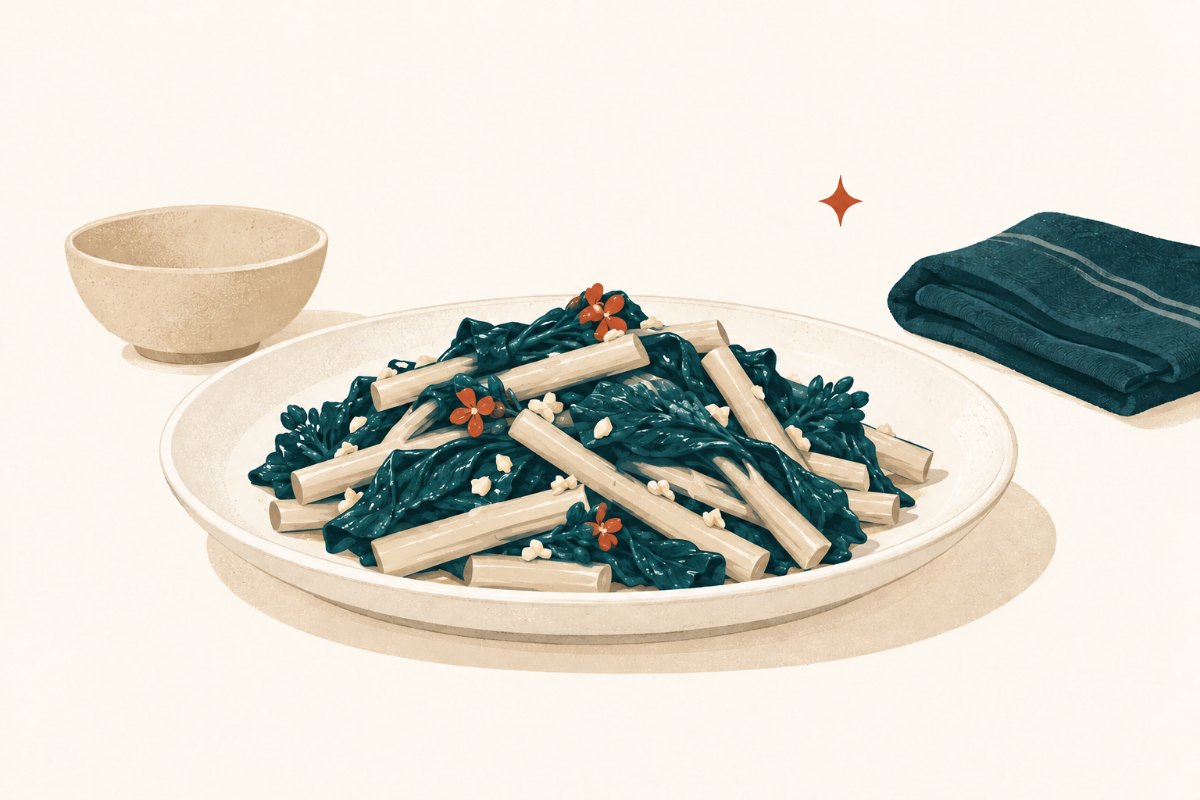
Garlic choy sum stir-fry cooks fast, but success depends on work done before the pan gets hot. Dry the greens, separate the slower stems from the quick leaves, and divide one pound of choy sum into two shallow skillet batches. Those choices give a home burner room to keep sizzling instead of turning the stir-fry into a watery braise.
This version uses garlic, salt, a small amount of sugar, and exactly two tablespoons of water. The water is divided between the batches and added only after the stems have had a head start. The result should be glossy, tender-crisp stems, wilted leaves, and pale fragrant garlic—not dark garlic or a puddle.
Verification note: This is a source-verified home-stove adaptation, not a recipe kitchen-tested by Not Hard to Cook. The dish identity, vegetable preparation, produce safety, and technique were researched; the exact skillet ratios and 25-minute elapsed time still need a documented test cook.
Why This Recipe Works
- Stems and leaves get different treatment: The thicker stems start first; tender leaves and yellow flowers enter later so they do not collapse while the stems catch up.
- Two shallow batches protect the pan’s heat: Half a pound at a time fits a 12-inch skillet more loosely than the full amount, so moisture can escape.
- Water is measured: One tablespoon per batch supplies a short covered steam, without turning an imprecise “splash” into a watery result.
- Garlic cooks before the burner returns to high: Ten to 15 seconds over medium heat develops aroma while keeping the mince pale enough to survive the rest of the stir-fry.
- Salt waits until the finish: Late seasoning limits the time that salt can draw water from the greens inside the pan.
Recipe at a Glance
| Prep | Cook | Additional | Total | Yield | Difficulty |
|---|---|---|---|---|---|
| 15 minutes | 10 minutes | None | 25 minutes | 4 side-dish servings | Easy |
Major US allergens are not required by the base formula, but products and shared kitchens vary. Check the cooking-oil label and cross-contact information when medically relevant. Do not infer that a restaurant version has the same ingredients: oyster sauce, soy sauce, stock, or cooking wine may introduce mollusc, soy, or wheat.
About Garlic Choy Sum Stir-Fry
The name 蒜蓉菜心 is used for choy sum with garlic by the Cantonese cooking project Made With Lau. In Jyutping, this article renders it as syun3 jung4 coi3 sam1. The reading for 蒜蓉, minced or crushed garlic, is documented as syun3 jung4; the Hong Kong Cantonese dictionary Words.hk gives 菜心 as coi3 sam1. This romanization is therefore a transparent combination of verified word readings, not a claim that every speaker uses one English spelling.
Made With Lau identifies direct stir-frying from raw as Cantonese 生炒 (saang1 caau2) and uses that approach for choy sum. A separate Hong Kong home-cooking source, Cherry & Dennis, describes 蒜蓉炒菜心 as a common simple vegetable side and also emphasizes washing, draining, adequate heat, and avoiding excess water. Together, those sources support a Cantonese and Hong Kong home- cooking context for the dish.
This site formula is still an adaptation. It specifies a 12-inch skillet, two batches, and a fixed water amount for an ordinary home stove. It does not claim one canonical garlic ratio, pan, seasoning balance, or texture for every Cantonese household.
Choosing and Preparing Choy Sum
Choy sum is also sold as choi sum, yu choy sum, or Chinese flowering cabbage. It is not the same vegetable as bok choy or mature gai lan, even when store labels blur the names. The University of Florida IFAS describes choy sum as a brassica grown for flowering stems bearing leaves. Its shoots can include small yellow flowers.
Choose bunches with bright leaves and slender, springy stems. Made With Lau recommends younger, smaller greens and warns that thick stems with a white core signal a more mature, tougher bunch. Avoid extensive yellowing, sliminess, deep bruising, or limp stems. Open yellow flowers are not spoilage by themselves: IFAS states that the above-ground plant is edible, including leaves, stems, and flower structures. Fully flowered bunches may simply be more mature, so inspect the stem texture rather than discarding sound greens because of blossoms.
This method keeps sound yellow flowers attached. Trim only dry, split, or woody ends. If a stem is thick and white-cored, peel or remove the fibrous lower portion; do not expect the quick timing to tenderize a genuinely woody piece.
Equipment
- 12-inch (30-cm) skillet with a lid: The stated two-batch method is built around this cooking area. Stainless steel or seasoned carbon steel is preferred. A seasoned 14-inch (36-cm) wok with a lid works, but retain two batches unless the full quantity remains shallow and tosses freely. If using nonstick cookware, follow its maker’s empty-preheat and maximum-heat limits.
- Large colander or salad spinner: Surface water is a recipe variable here, not a minor detail. A spinner is efficient; a colander plus clean towels works.
- Wide spatula or long tongs: Use a tool that lifts stems from the bottom and turns leaves without compressing them into a dense layer.
- Separate prep bowls: Keep stems, leaves, divided garlic, and measured seasonings ready. Stir-frying moves too quickly to stop and measure safely.
Ingredients
Garlic choy sum
- 1 pound (454 g) choy sum, untrimmed grocery weight, washed, dried thoroughly, stems and leaves separated, and cut into 2 1/2-inch (6-cm) lengths
- 2 tablespoons (30 ml) neutral high-heat cooking oil, divided
- 5 medium garlic cloves (about 15 g), finely minced and divided
- 2 tablespoons (30 ml) cool water, divided
- 1/2 teaspoon fine salt, divided
- 1/2 teaspoon granulated sugar, divided
Substitutions and allergens: The base formula has no intentionally added ingredient among the major US allergens, but that is not a universal allergen-free promise. Check the oil label and kitchen cross-contact. Do not substitute bottled oyster sauce or soy sauce without accounting for sodium, extra liquid, and possible mollusc, soy, or wheat. Gai lan and bok choy have denser stems and are not timing-equivalent substitutes. Jarred garlic has a different moisture and acidity profile; it is not asserted as an exact swap.
Mise en Place
- Wash safely. Wash hands, then hold the choy sum under cool running water and gently rub the stems, leaves, and flower clusters. The FDA says plain running water is appropriate and that soap or commercial produce wash is unnecessary. Cut away damaged tissue.
- Dry thoroughly. Let the greens drain, spin them, then blot lingering droplets with a clean towel or paper towel. Water hidden where leaves meet a stem still counts; it cools the skillet and adds to the measured cooking water.
- Separate by cooking speed. Cut the leafy tops away from the thicker lower stems, then cut both into 2 1/2-inch (6-cm) lengths. Keep edible yellow flowers with the leaves.
- Make two equal batches. Divide stems and leaves into two piles, each derived from about 8 ounces (227 g) of the original untrimmed bunch. Divide the garlic, oil, water, salt, and sugar in half. Mix the salt and sugar so each batch can be seasoned evenly in seconds.
- Clear the stove area. Put the lid and serving plate within reach. Once the garlic reaches the oil, do not leave the pan to find an ingredient.
How to Make Garlic Choy Sum Stir-Fry
- Preheat the skillet. Heat an empty 12-inch (30-cm) skillet over medium- high for 1 to 2 minutes. A water drop should evaporate promptly rather than sit still. Wipe the skillet dry. Smoke means the pan is too hot; move it off the burner briefly and lower the heat.
- Fragrance the oil without browning the garlic. Add 1 tablespoon oil and swirl. When it moves freely and shimmers without smoking, reduce the heat to medium. Add half the garlic and stir for 10 to 15 seconds, until aromatic but still pale. Dark-brown garlic will turn bitter.
- Give the stems a head start. Raise the heat to high and add half the stems. Toss for about 45 seconds. Listen for an active sizzle and look for a glossy surface. If the pan falls silent immediately, the batch is too wet or crowded; keep tossing uncovered rather than adding water early.
- Add the leaves. Add half the leaves and flowers. Toss for 30 seconds, repeatedly lifting the wetter leaves from the bottom so steam can escape.
- Cover with a measured tablespoon of water. Pour 1 tablespoon water around the hot pan edge, then cover for 45 to 60 seconds. Open the lid away from your face. Leaves should be wilted and bright green; a knife should enter the thickest stem with slight resistance rather than meet a hard raw center.
- Season late and remove excess liquid. Add half the salt-sugar mixture and toss over high heat for 20 to 30 seconds. A thin sheen is right. If liquid collects, remove the greens to the serving plate, boil the liquid for 30 to 60 seconds until almost gone, then return the greens for one quick toss.
- Cook the second batch. Empty the pan, reheat it over medium-high for about 30 seconds, and repeat with all remaining ingredients. Combine the two batches on the plate and serve at once.
Critical Technique Notes
Dry greens are part of heat control
A stir-fry can contain water and still require dry ingredients. The difference is control. Water clinging unpredictably to one pound of leaves can cool the pan before the stems sear and can turn one measured tablespoon into several. Drying first lets the recipe add water when the pan is hot enough to make steam.
Batch depth matters more than the word “high”
Home burners and pans vary. “High heat” does not guarantee evaporation if cold, wet greens are stacked deeply. In a 12-inch skillet, the two-batch instruction keeps more vegetable in contact with hot metal and leaves gaps for steam to escape. If using a wok, the same principle applies: do not fill it so deeply that the greens can only steam in their own liquid.
Use cues rather than chasing smoke. Oil should shimmer and flow, stems should sizzle when they land, and steam should rise once the water is added. Smoking oil is not a success cue. Move the pan off the burner and reduce the setting.
Garlic must stay ahead of browning
Finely minced garlic burns faster than the stems soften. Starting it briefly at medium heat, then immediately adding the moist stems, limits that risk. Fragrant and pale to light gold is the endpoint. If flecks become dark brown, pull the pan off the burner for 10 seconds and add the stems; do not keep frying to a uniform dark color.
Tender-crisp is a physical cue
The exact cook time changes with stem diameter, pan material, burner output, and how much water remained after drying. Test the thickest stem. It should bend and accept the tip of a small knife with slight resistance, while the leaves are wilted but still green. If the center is hard, add one teaspoon—not another unmeasured splash—of water, cover for 20 seconds, and check again.
Troubleshooting
| Problem | Likely cause | Fix now | Prevent next time |
|---|---|---|---|
| A puddle forms | Wet greens, a crowded pan, or more than 1 tablespoon water in the batch | Transfer greens to the plate; boil liquid over high for 30–60 seconds, then return greens for one toss | Spin and blot the greens; use two shallow batches and measure the water |
| Stems are hard but leaves are soft | Stems and leaves started together, or stems were mature | Remove leaves; add 1 teaspoon water to stems, cover 20 seconds, and retest | Separate the parts and choose slender springy stems without a white core |
| Garlic tastes bitter | It browned before the greens entered | Remove any clearly burned pieces; finish the greens in fresh oil if necessary | Use medium heat for garlic and stop at fragrant and pale |
| The pan never sizzles | Greens were too wet, pan was underheated, or batch was deep | Keep the pan uncovered and toss until steam decreases; do not add more water yet | Preheat 1–2 minutes, dry well, and divide the batch |
| Leaves scorch before stems soften | Too little controlled steam or uneven cuts | Add 1 teaspoon water, cover for 20 seconds, then check | Cut uniform 2 1/2-inch pieces and add the measured tablespoon after the leaves |
| Greens turn dull and limp | They stayed covered or in the hot pan too long | Plate immediately; texture cannot be restored | Check at 45 seconds covered and serve as soon as the second batch finishes |
| Dish tastes too salty | Salt was not divided, or a bottled seasoning was added | Fold in unseasoned cooked greens if available; added water will only make it wet | Divide seasoning before cooking and do not add soy or oyster sauce blindly |
Variations
Add ginger
For a garlic-and-ginger version, add four thin slices of peeled ginger (about 5 g total), divided. Fry each half for 10 seconds before adding that batch’s garlic, then continue as written. The flavor will be warmer and less purely garlic-forward. This variation does not change the stated batch size.
Oyster-sauce finish
For a saucier variation, whisk 1 tablespoon (15 ml) oyster sauce with the full 2 tablespoons water. Omit the salt at first, divide the mixture between the two batches, and taste only after both are combined. Oyster sauce introduces mollusc and may contain wheat or soy; check the complete label. Vegetarian mushroom stir-fry sauce changes the flavor and may still contain soy or wheat. Because the base formula has not been test-cooked, this remains a researched variation rather than a verified one-for-one seasoning replacement.
Do not use this timing for bok choy or gai lan
Bok choy and mature gai lan are related greens, not a drop-in variation. Their stems differ in density and shape, so they need their own cut and timing. Use a dedicated recipe instead of forcing their doneness into this choy sum clock.
Serving Suggestions
Serve garlic choy sum immediately as one vegetable component of a shared meal. Four side-dish servings assume rice and at least one other dish. Its simple garlic profile pairs well with steamed fish, shrimp and scrambled eggs, or soy sauce noodles without adding another heavy sauce.
Storage and Reheating
- Refrigerate: Move leftovers to a shallow covered container and refrigerate within 2 hours, or within 1 hour when the ambient temperature is above 90°F (32°C). Use within 3–4 days. The stems and leaves will soften in storage.
- Freeze: Freezing is not recommended for texture. If avoiding waste matters more than crispness, seal and freeze promptly for up to 3–4 months under USDA general leftover guidance; expect very soft leaves after thawing in the refrigerator.
- Reheat: Put the greens in a skillet with 1 teaspoon water, cover, and heat over medium until the center reaches 165°F (74°C), then uncover briefly to remove excess moisture. Reheat only the portion needed; repeated heating further softens the vegetable.
Frequently Asked Questions
Are the yellow flowers on choy sum edible?
Yes. University of Florida IFAS identifies the above-ground portions of choy sum as edible and describes the crop’s flowering shoots. Keep sound yellow flowers and wash them with the leaves. Flowers do not automatically mean spoilage, although a heavily flowered bunch may have more mature, firmer stems.
Is choy sum the same as bok choy?
No. Both are brassicas, but choy sum is a flowering-stem vegetable with slender green stalks and often small yellow flowers. Bok choy forms broader spoon-shaped stems. This recipe’s cut and timing are specific to choy sum.
Do I need a wok?
No. The method is deliberately specified for a lidded 12-inch skillet and two batches. A 14-inch wok is a valid alternative, but its extra room does not make drying, staging, or heat cues optional.
Why cook the recipe in two batches?
One pound of leafy greens collapses dramatically, but it starts bulky and cool. Putting all of it into a skillet at once traps steam and lowers the surface temperature. Two shallow batches help the stems contact the pan and let unwanted water escape.
Can I leave out the sugar?
Yes. Omit it for a more purely savory profile. Sugar here balances slight mustard bitterness in mature greens; it is not meant to make the dish sweet. Do not replace it with a liquid sweetener without reducing another liquid.
How do I fix watery choy sum?
Move the greens to the serving plate before they overcook. Boil the liquid in the empty skillet for 30–60 seconds until nearly gone, then return the greens for one quick toss. Next time, dry more thoroughly, keep the two batches, and measure only 1 tablespoon water per batch.
Is this recipe allergen-free?
No universal allergen-free claim is made. The base ingredients do not intentionally require a major US allergen, but product labels and shared-kitchen cross-contact vary. Restaurant and variation versions may include oyster sauce, soy sauce, stock, or cooking wine with mollusc, soy, or wheat.
Recipe Card
Garlic Choy Sum Stir-Fry
Choy sum stems and leaves are cooked in two shallow skillet batches with pale fragrant garlic, a measured splash of water, and late seasoning for tender- crisp greens without a puddle.
Original name: 蒜蓉菜心 (syun3 jung4 coi3 sam1)
Prep: 15 minutes
Cook: 10 minutes
Total: 25 minutes
Yield: 4 side-dish servings
Difficulty: Easy
Equipment
- Lidded 12-inch (30-cm) skillet; or seasoned 14-inch (36-cm) wok with lid
- Large colander or salad spinner
- Wide spatula or long tongs
- Prep bowls and a serving plate
Ingredients
- 1 pound (454 g) choy sum, untrimmed grocery weight, washed, dried thoroughly, stems and leaves separated, and cut into 2 1/2-inch (6-cm) lengths
- 2 tablespoons (30 ml) neutral high-heat cooking oil, divided
- 5 medium garlic cloves (about 15 g), finely minced and divided
- 2 tablespoons (30 ml) cool water, divided
- 1/2 teaspoon fine salt, divided
- 1/2 teaspoon granulated sugar, divided
Instructions
- Wash and dry the choy sum. Trim only dry, split, or woody stem ends. Separate the stems and leaves, keeping edible yellow flowers. Rinse every piece under cool running water while gently rubbing away visible grit; do not use soap or produce wash. Drain, then spin or pat completely dry with clean towels. Cut stems and leafy sections into 2 1/2-inch (6-cm) lengths and keep them in separate bowls.
- Divide the batches. Divide both the stems and leaves into two equal batches, each derived from about 8 ounces (227 g) of the untrimmed bunch, so the 12-inch (30-cm) skillet will not be packed deeply. Divide the minced garlic, oil, water, salt, and sugar in half. Put the measured water beside the stove and mix the salt and sugar together so each batch can be seasoned quickly.
- Preheat the skillet. Heat the empty 12-inch (30-cm) skillet over medium- high for 1 to 2 minutes. It is ready when a single drop of water evaporates promptly rather than sitting still; wipe the pan dry before adding oil. If the pan smokes, remove it from the heat briefly and lower the burner.
- Start the first batch. Add 1 tablespoon oil and swirl. When the oil flows easily and shimmers without smoking, reduce the heat to medium, add half the garlic, and stir for 10 to 15 seconds, just until fragrant and still pale. Immediately raise the heat to high, add half the stems, and toss for 45 seconds. The stems should sizzle and begin turning glossy; if the garlic colors dark brown, pull the skillet off the heat for 10 seconds.
- Add leaves and measured water. Add half the leaves and flowers and toss for 30 seconds, lifting the wetter leaves from the bottom. Pour 1 tablespoon water around the hot edge of the skillet, not into the oil in one spot, and cover for 45 to 60 seconds. Uncover carefully away from your face. The leaves should be wilted and bright green while the thickest stem offers slight resistance when pierced.
- Season and correct the moisture. Sprinkle half the salt-sugar mixture over the greens and toss over high heat for 20 to 30 seconds. If more than a thin sheen of liquid remains, move the greens to the serving plate and boil the liquid for 30 to 60 seconds until almost gone; return the greens for one quick toss. Do not keep cooking the leaves while reducing a puddle. Transfer the batch to the plate.
- Repeat and serve. Return the empty skillet to medium-high for about 30 seconds, then repeat with the remaining oil, garlic, stems, leaves, flowers, water, salt, and sugar. Combine both batches on the serving plate and serve immediately. The garlic should be fragrant and pale to light gold, never dark brown, and the plate should hold glossy greens rather than a pool of cooking liquid.
Storage: Refrigerate within 2 hours, or 1 hour above 90°F (32°C), and use within 3–4 days. Reheat covered with 1 teaspoon water to 165°F (74°C), then uncover briefly. Freezing is possible under general leftover guidance but is not recommended for the texture of the leaves.
Verification: Source-verified, not kitchen-tested by Not Hard to Cook.
Nutrition Information
Nutrition information has not been independently verified and is not provided.