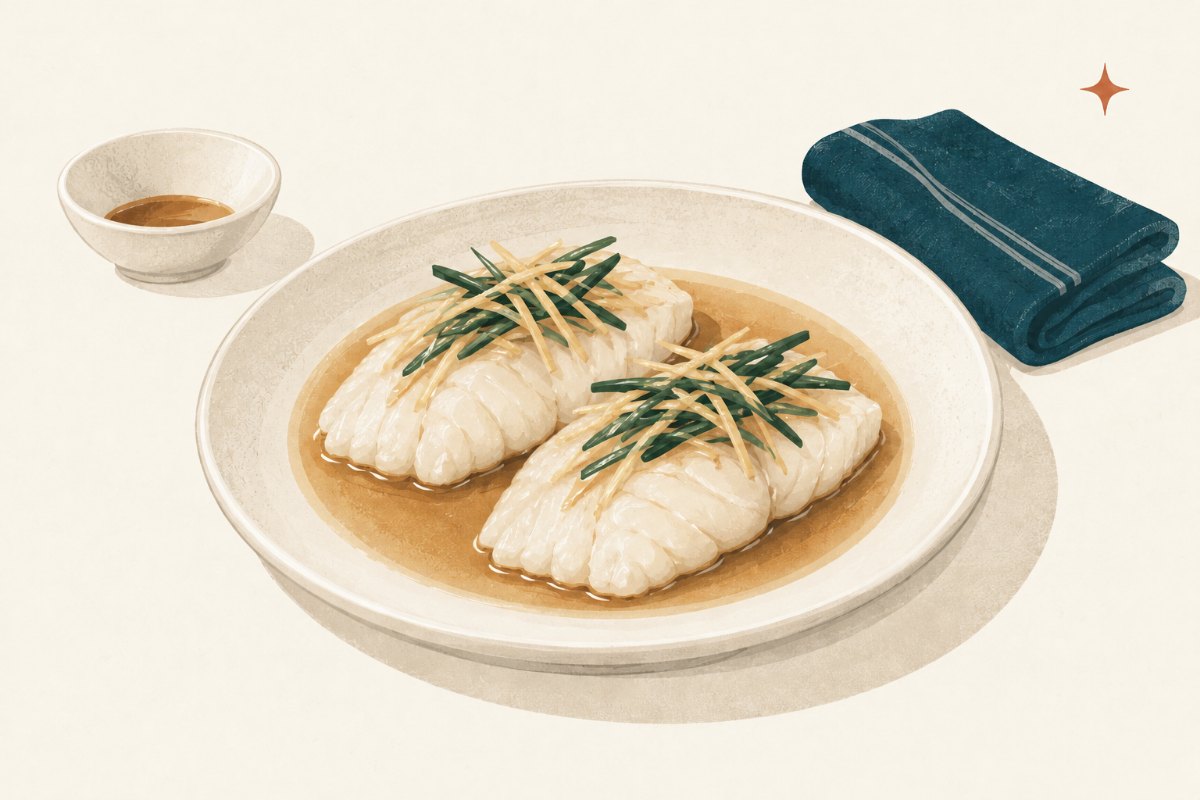
Steamed fish fillet with ginger and scallion gives you the light soy, fresh aromatics, and hot-oil finish associated with Cantonese steamed fish without requiring a whole fish or a dedicated steamer.
This adaptation fixes the variables that often get left vague. Use two white- fish portions of the same thickness, keep them in one layer on a measured plate, and check each center with a thin thermometer probe. The clock tells you when to start checking; 145°F (63°C) tells you when the fish is safely cooked.
Verification note: This formula is source-verified, not kitchen-tested by Not Hard to Cook. The cultural context, seafood safety, and oil-safety controls were checked against the linked sources. The exact plate, steam time, sauce balance, and finished texture still need a documented test cook.
Why this recipe works
- Thickness is specified: Two 3/4–1-inch (2–2.5-cm) portions are easier to place and check evenly than an unspecified fillet by weight alone.
- The setup fits ordinary cookware: A 9-inch (23-cm) plate sits on a stable rack inside a wide covered pot or deep skillet, above—not in—the water.
- Temperature settles doneness: Opaque, separating flakes are useful quality cues, but both portions must reach 145°F (63°C).
- Sauce and oil stay separate: Diluted soy goes directly on the fish. The oil is heated alone, switched off, and spooned over dry aromatics in small amounts.
Recipe at a glance
| Prep | Cook | Additional | Total | Yield | Difficulty |
|---|---|---|---|---|---|
| 15 minutes | 25 minutes | None | 40 minutes | 2 main-dish servings | Intermediate |
Key constraint: The pot must fit a 9-inch (23-cm) plate on a stable rack with the lid fully closed. Major allergens: fish, soy, and commonly wheat.
About Cantonese-style steamed fish fillet
A Hong Kong Department of Health publication describes steaming as a common method for seafood in Cantonese cuisine and documents a restaurant fish fillet steamed with ginger and spring onion. The ginger-scallion, light-soy, hot-oil pattern is also well established in Cantonese recipe sources.
The stronger traditional and celebratory reference is a whole fish. This page adapts the technique to two skinless portions that fit ordinary cookware; it does not claim that a fillet has the same table presentation or symbolic meaning. No standardized original-language name for this exact adaptation was verified, so none is invented.
Which fish to buy
Choose a delicate white fish with mild aroma and firm-looking flesh. Cod, haddock, and sea bass are suitable here. The canonical quantity is one 10-ounce (285-g) center-cut fillet divided into two pieces, each 3/4–1 inch (2–2.5 cm) thick at its thickest point.
Avoid mixing a thin tail piece with a thick center portion. If the tail cannot be trimmed into the same thickness, use the thin-fillet variation below. Oily or firm fish such as mackerel or swordfish will taste and behave differently and are not presented as drop-in equivalents.
FoodSafety.gov advises buying refrigerated or properly iced fish with a mild, fresh smell and no dried or darkened edges. Frozen fish is workable when the package is intact and the fillet is thawed overnight in the refrigerator. The cooking range does not cover a frozen center.
Equipment and ordinary-pot setup
- Covered wide pot or deep skillet: Use a 12-inch/30-cm vessel with at least 10.5 inches/27 cm of clear internal diameter, or a wide 6-quart/5.7-litre pot. A wok or dedicated metal steamer works when it fits the same plate.
- Stable steaming rack: It should be about 1.5–2 inches/4–5 cm tall and rated for use inside cookware. Do not balance the plate on an unstable improvised object.
- Rimmed heatproof plate: A 9-inch/23-cm plate catches liquid and leaves room for removal. It must sit level without touching the lid.
- Thin-probe thermometer: The sensing tip must fit into a 3/4-inch/2-cm portion and reach its center from the side.
- Small saucepan with lid: A dry 1-quart/1-litre pan heats the finishing oil. Keep its lid nearby whenever oil is on the burner.
- Dry oven mitts and long-handled metal spoon: Wet cloth transfers heat and is not a safe plate lifter. A purpose-made plate lifter can assist dry mitts.
Before heating anything, set the empty plate on the rack, add water below it, and close the lid. This cold dry-fit confirms stability and clearance without asking you to rearrange hot cookware.
Ingredients
Fish and steaming aromatics
- 1 skinless center-cut cod, haddock, or sea bass fillet, 10 ounces (285 g), fully thawed, pin bones removed, patted dry, and cut into 2 equal 3/4–1-inch (2–2.5-cm) portions
- 20 g (about 3/4 ounce) fresh ginger, peeled; half thinly sliced and half cut into fine 2-inch (5-cm) matchsticks
- 3 medium scallions, whites cut into 2-inch (5-cm) lengths and greens cut into fine 2-inch (5-cm) dry strips
- Water to reach 1–1 1/2 inches (2.5–4 cm) deep in the steamer, always below the plate
Soy and hot-oil finish
- 1 tablespoon (15 ml) light soy sauce
- 2 tablespoons (30 ml) hot water for the sauce
- 1/4 teaspoon granulated sugar
- 1 1/2 tablespoons (22 ml) neutral cooking oil
Substitutions and allergens: Fish is a US major allergen; identify the species you serve. Light soy sauce contains soy and commonly wheat, as shown by product-specific labels, so inspect your bottle and any cross-contact note. Equal-volume reduced-sodium soy makes a milder finish. Tamari can be saltier or darker and supports a gluten-free claim only when the exact label and kitchen handling do. This page makes no allergen-free claim. Use the same- thickness fish substitution or the thinner-fillet variation rather than assuming every white fish shares one time.
Mise en place
- Thaw frozen fish overnight in the refrigerator. Keep it refrigerated until preparation, then wash hands and separate its board and utensils from ready- to-eat scallion and ginger.
- Do not rinse the raw fish. Current FDA home food-safety guidance advises against washing raw fish because splashes can spread contamination. Remove pin bones with clean tweezers, pat the surface dry, portion it, and measure the thickest point.
- Prepare the steaming ginger/scallion and finishing ginger/scallion separately. Pat the finishing strips completely dry so water does not meet hot oil.
- Dissolve the sugar in the hot water and stir in the light soy. Keep this water-based sauce away from the oil saucepan.
- Cold-fit the rack, water, plate, and lid. Set a dry heatproof trivet beside the stove, place dry mitts nearby, and confirm the thermometer is clean.
How to make steamed fish fillet with ginger and scallion
- Prepare the fish, aromatics, and sauce. Do not rinse the raw fish. Check for pin bones, pat it dry, and cut it crosswise into 2 equal portions, each 3/4–1 inch/2–2.5 cm thick. Divide the ginger and scallions as listed. In a small bowl, dissolve 1/4 teaspoon sugar in 2 tablespoons hot water, then stir in 1 tablespoon light soy sauce.
- Build and preheat the steamer. Set a stable 1.5–2-inch/4–5-cm rack inside a covered 12-inch/30-cm deep skillet or wide pot. Add 1–1 1/2 inches/2.5–4 cm water, keeping it below the plate. Dry-fit the empty 9-inch/23-cm plate so it sits level with clearance and the lid closes, remove the plate, then cover and bring the water to a full boil over high heat, allowing up to 7 minutes.
- Arrange the fish. Lay the scallion whites and sliced ginger on the plate, then set the 2 fish portions on top in one layer without overlap. Keep the thickest areas toward the outside of the plate and leave a small gap between the pieces.
- Steam and verify doneness. When the water is boiling steadily, use dry mitts to place the fish plate on the rack. Cover, reduce only enough to maintain strong steady steam, and steam for 7 minutes. Open the lid away from your face and insert a clean thin probe from the side into the thickest center of each portion. If either is below 145°F/63°C, cover and steam in 1-minute increments until both reach 145°F/63°C; expect about 7–10 minutes for the specified thickness, but temperature decides.
- Remove the hot plate. Turn off the steamer. Open the lid away from your face and wait several seconds for the first rush of steam to clear. Use dry mitts or a plate lifter plus dry mitts to move the plate to a dry heatproof trivet. Spoon off and discard the accumulated steaming liquid without tilting the hot plate, then discard the cooked ginger slices and scallion whites.
- Add the sauce and fresh aromatics. Spoon the diluted soy sauce around and over the fish. Arrange the dry ginger matchsticks and scallion-green strips on top, keeping the garnish in a compact line so the finishing oil can reach it.
- Heat the oil safely. Place 1 1/2 tablespoons neutral oil in a dry 1-quart saucepan with its lid nearby. Heat over medium-high while staying at the stove for 1–2 minutes, until the oil shimmers but does not smoke. If it smokes, turn off the burner and let it cool; do not pour it. Turn off the burner before finishing the fish.
- Spoon the oil and serve. Keep the fish plate on the heatproof trivet beside the stove. With face and hands back, use a long-handled metal spoon to drizzle the hot oil over the dry ginger and scallion in small spoonfuls; it should sizzle. Leave the oil pan on the switched-off burner, then serve the fish immediately.
Critical technique notes
Thickness starts the clock; temperature stops it
A 10-ounce fillet can be long and thin or short and thick. Weight alone cannot set steaming time. Begin checking these 3/4–1-inch portions at 7 minutes, but expect the plate, steam recovery, fish species, and starting temperature to change the result.
Place a thin probe in the center
USDA FSIS directs cooks to the thickest portion or center of fish. For a thin food, a side entry helps the probe’s sensing area reach the center. Check both portions because size and position can make them finish at different times.
Opaque flesh that separates easily is a useful visual cue. It does not replace the 145°F (63°C) reading required here.
Do not borrow a rest time from meat
The federal minimum-temperature chart specifies a 3-minute rest for several whole cuts of meat. It does not list a rest for fish. The fish may continue to heat on its plate, but that rise is variable. Do not remove a 140°F center and assume carryover will make it safe.
Keep water below the plate
The rack must remain stable and keep the plate above the water. Use enough water to sustain steam without boiling dry, but not enough to bubble against the plate. If the water is low before the fish is done, stop the heat before carefully adding boiling water down the side of the vessel—never splash the hot plate.
Treat steam and the plate as burn hazards
Open the lid away from your face and arms. Let the first rush of steam clear, then use dry mitts. Spoon off liquid on a stable trivet instead of tilting a hot, slippery plate over the sink.
The oil should shimmer, not smoke
The US Fire Administration advises staying with heated oil and turning off the burner if it smokes. Dry the garnish, switch off the heat, and spoon the oil while the pan stays on the burner. If an oil fire starts, slide the lid over the pan, turn off the burner, and never use water.
Troubleshooting
| Problem | Likely cause | Fix now | Prevent next time |
|---|---|---|---|
| One portion is below 145°F | Pieces differed in thickness or placement | Remove any done piece to a clean warm plate; steam the cooler one in 1-minute increments | Cut equal center portions and check both |
| Fish is firm and dry | It steamed past the safe endpoint or sat in hot liquid | Spoon on a little diluted sauce; texture cannot be reversed | Begin checking at 7 minutes and drain promptly |
| Fish sticks to the plate | Too little aromatic support or fragile handling | Release it with a thin fish spatula before serving | Make a level bed of scallion whites and ginger |
| Sauce tastes watery | Steaming liquid remained on the plate | Spoon off excess liquid, then add a small amount of measured soy | Drain by spoon before adding sauce |
| Sauce tastes too salty | Soy brand is concentrated or water was reduced | Add hot water 1 teaspoon at a time around the fish | Keep the 1:2 soy-to-water ratio and check the label |
| Fresh garnish does not sizzle | Oil was not shimmering or garnish was wet | Leave it as a fresh garnish; do not re-pour oil blindly | Dry garnish and heat oil immediately before serving |
| Oil begins smoking | Heat is too high or pan is too hot | Turn off burner and let oil cool; do not pour | Stay at the stove and stop at a visible shimmer |
| Steam weakens early | Lid leaks, burner is too low, or water is depleted | Restore a steady boil; add boiling water only with heat off and away from the plate | Cold-fit the lid and start with 1–1 1/2 inches water |
Variations
Thinner white-fish fillet
For two equal pieces about 1/2 inch (1.3 cm) thick, begin checking at 4 minutes; published specialist guidance gives roughly 4–5 minutes for very thin fillets. Do not assume they are done at 5 minutes—verify 145°F (63°C) at the center with a thin probe. The thinner fish will have less margin before it dries.
Same-thickness haddock or sea bass
Replace cod with the same 10-ounce (285-g) total of haddock or sea bass and keep the 3/4–1-inch portion thickness. Haddock tends to separate into a finer flake; sea bass can taste richer. Use the same first-check point but let each portion’s temperature determine the finish.
No-sizzle finish
Omit the 1 1/2 tablespoons oil. Put the diluted soy sauce, ginger matchsticks, and scallion-green strips in the small saucepan; bring just to a bubble for 30 seconds, then spoon everything over the fish. This finish is lighter and less glossy, with softer aromatics and none of the fresh-garnish sizzle.
Serving suggestions
Serve one fish portion per person with steamed rice and a vegetable side. The diluted soy is designed to season the fish and a small amount of rice, not to make a large bowl of sauce.
Storage and reheating
- Refrigerate: Put leftovers in a shallow covered container within 2 hours, or within 1 hour above 90°F (32°C). Refrigerate at 40°F (4°C) or below and use within 3–4 days.
- Freeze: Freeze airtight at 0°F (-18°C) for up to 3 months for best quality, following USDA fish-storage guidance. Thaw in the refrigerator. Expect a firmer, drier texture and softer scallions.
- Reheat: Cover the fish with 1 tablespoon water and reheat gently in the microwave or over steam until the center reaches 165°F (74°C). Check with a clean thermometer and expect further firming.
Frequently asked questions
What fish works best for this recipe?
Use a delicate white fish with a center-cut portion 3/4–1 inch (2–2.5 cm) thick. Cod, haddock, or sea bass fits the selected method. Species matters less than uniform thickness for timing, but each has a different flavor and flake.
Do I need a wok or bamboo steamer?
No. A wide covered pot or deep skillet works when a stable rack holds the 9-inch (23-cm) plate above the water and the lid closes fully. Dry-fit everything while cold; if the plate wedges against the walls, choose a smaller plate or larger vessel.
Can I judge doneness by flaking the fish?
Use flaking and opacity as secondary quality cues. This recipe requires a clean thin-probe reading of 145°F (63°C) in the thickest center of both portions. That avoids asking appearance or an imprecise knife test to carry the safety decision.
Should I rinse the fillet first?
No. Current FDA guidance advises against rinsing raw fish because splashes can spread contamination. Remove pin bones, pat the surface dry, and wash hands, utensils, and contacted surfaces after raw-fish preparation.
Is the hot-oil finish required?
It is part of this canonical flavor and aroma profile, but it is not required for the fish to cook. Use the no-sizzle variation if you are not comfortable handling hot oil. Do not pour oil that is smoking.
Recipe card
Steamed Fish Fillet with Ginger and Scallion
Two evenly thick white-fish portions are steamed over ginger and scallion, checked at 145°F/63°C, then finished with diluted light soy, fresh aromatics, and carefully spooned hot oil.
- Prep: 15 minutes
- Cook: 25 minutes
- Total: 40 minutes
- Yield: 2 main-dish servings
- Difficulty: Intermediate
- Verification: Source-verified, not kitchen-tested by Not Hard to Cook
Equipment
- Covered 12-inch/30-cm wide pot or deep skillet with at least 10.5 inches/27 cm clearance
- Stable 1.5–2-inch/4–5-cm steaming rack
- 9-inch/23-cm rimmed heatproof plate
- Thin-probe instant-read thermometer
- Dry oven mitts or a purpose-made plate lifter plus dry mitts
- Dry 1-quart/1-litre saucepan with lid
- Long-handled metal spoon and dry heatproof trivet
Ingredients
Fish and steaming aromatics
- 1 skinless center-cut cod, haddock, or sea bass fillet, 10 ounces (285 g), fully thawed, pin bones removed, patted dry, and cut into 2 equal 3/4–1-inch (2–2.5-cm) portions
- 20 g (about 3/4 ounce) fresh ginger, peeled; half thinly sliced and half cut into fine 2-inch (5-cm) matchsticks
- 3 medium scallions, whites cut into 2-inch (5-cm) lengths and greens cut into fine 2-inch (5-cm) dry strips
- Water to reach 1–1 1/2 inches (2.5–4 cm) deep in the steamer, always below the plate
Soy and hot-oil finish
- 1 tablespoon (15 ml) light soy sauce
- 2 tablespoons (30 ml) hot water for the sauce
- 1/4 teaspoon granulated sugar
- 1 1/2 tablespoons (22 ml) neutral cooking oil
Instructions
- Prepare the fish, aromatics, and sauce. Do not rinse the fish. Remove pin bones, pat dry, portion, and measure. Prepare aromatics. Dissolve sugar in hot water and stir in soy sauce.
- Build and preheat the steamer. Set the rack over 1–1 1/2 inches water, always below the plate. Dry-fit the plate and lid, remove the plate, then cover and bring water to a full boil over high heat, allowing up to 7 minutes.
- Arrange the fish. Place scallion whites and sliced ginger on the plate. Set both fish portions on top in one layer, thick areas outward, without overlap.
- Steam and verify. Load the plate with dry mitts. Cover and maintain strong steady steam for 7 minutes. Probe each thickest center from the side. Continue in 1-minute increments until both reach 145°F/63°C; expect about 7–10 minutes.
- Remove the hot plate. Turn off heat, vent steam away, and move the plate to a dry trivet with dry mitts. Spoon off liquid; discard cooked aromatics.
- Add sauce and garnish. Spoon diluted soy around and over the fish. Place the dry ginger matchsticks and scallion greens compactly on top.
- Heat the oil safely. Heat oil in the dry lidded saucepan over medium-high, attended, until shimmering but not smoking, 1–2 minutes. Turn off the burner.
- Spoon the oil and serve. Keeping the pan on the switched-off burner, use the long-handled spoon to drizzle oil over the dry garnish in small amounts. Keep face and hands back, then serve immediately.
Notes
- Thickness starts the check; 145°F/63°C stops the cook. Check both portions.
- Do not count on carryover: official fish guidance provides no rest-time allowance.
- Keep water below the plate and open the lid away from your body.
- Fish, soy, and commonly wheat are allergens; check the exact soy-sauce label.
- If oil smokes, switch off the heat and let it cool. Never put water on an oil fire.
- Refrigerate promptly, use within 3–4 days, and reheat leftovers to 165°F/74°C.
Nutrition information
Nutrition information has not been independently verified and is not provided.