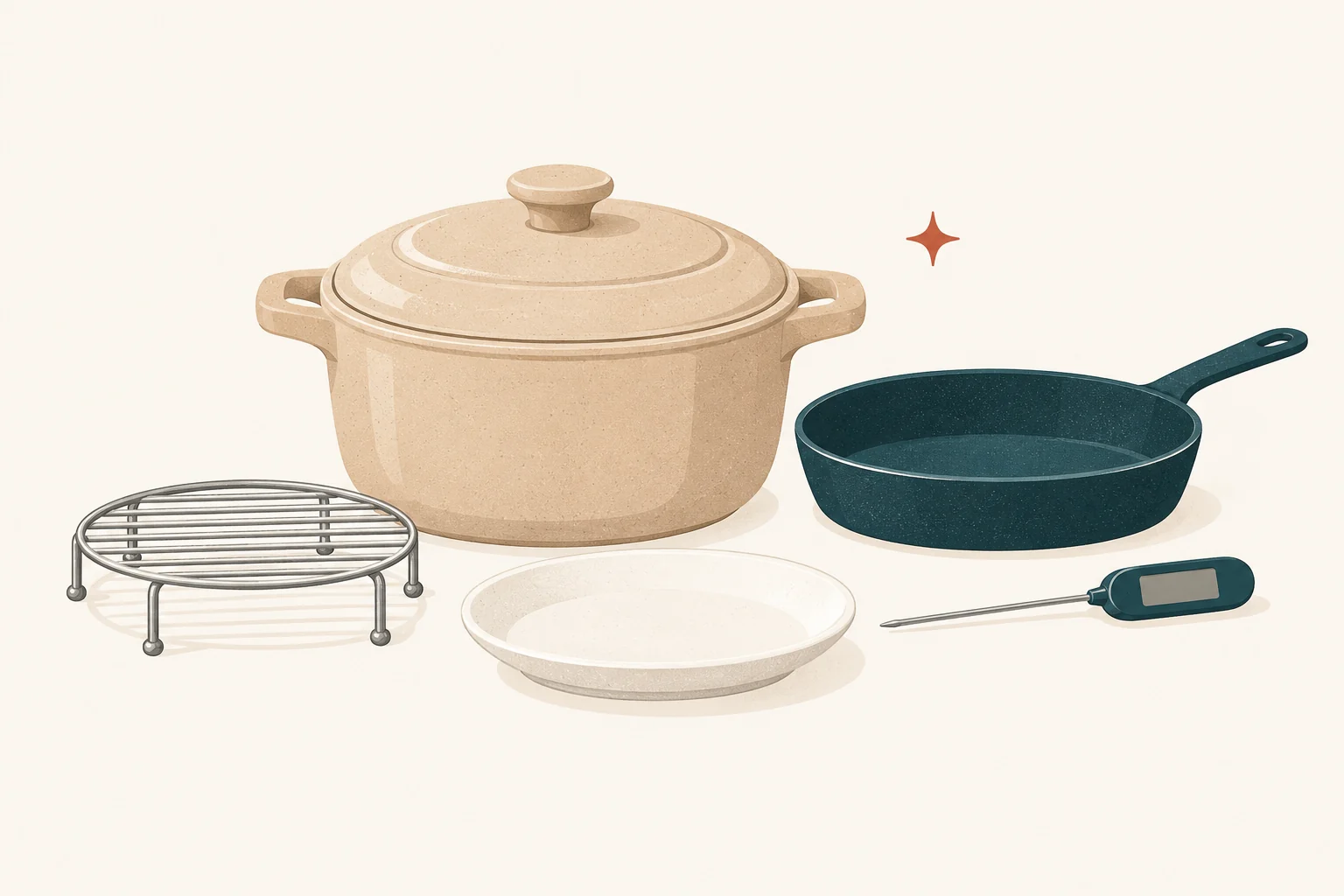
The essential Cantonese cooking equipment for beginners is probably smaller
than you expect: one wide pan that fits your burner, one covered pot that can
hold a stable steaming setup, a sharp general-purpose knife, a steady cutting
board, basic measuring tools, and a fast thin-tip food thermometer. A rice
cooker is optional. A wok, bamboo steamer, and Chinese vegetable cleaver can
wait.
Here, “essential” means useful for the beginner Cantonese recipes on this site.
It does not mean every Cantonese cook owns the same tools. The right setup
depends on your cooktop, the number of people you feed, the dishes you plan to
make, and the equipment already in your kitchen.
Difficulty: Beginner
Setup time: About 20 minutes to inventory, measure, and cold-fit equipment
Prerequisites: One recipe you want to cook, your cooktop manual, and the
care instructions for any pan, plate, or appliance you plan to use
The short rule: Start with ordinary equipment. Buy a specialty tool only
when you can name the repeated task it will make safer, easier, or more
reliable.
The compact setup at a glance
| Priority | Equipment | What to check |
|---|---|---|
| Use now | 10- to 12-inch skillet or sauté pan | Flat base fits the active burner; material suits the cooktop; handle is secure |
| Use now | Covered pot or deep pan | Lid closes over a stable rack and plate; water stays below the plate |
| Use now | Chef’s knife or santoku and cutting board | Knife is comfortable and sharp; board does not slide and can be cleaned |
| Add early | Heat-safe turner, tongs, small bowls, and measuring tools | Utensils suit the pan surface; bowls keep fast-cooking ingredients ready |
| Add early | Fast digital thermometer with a thin sensing tip | Probe can reach the center of thin pieces |
| Optional | Rice cooker | Capacity, cup, water lines, and programs match the rice you cook |
| Wait | Wok, bamboo steamer, cleaver, wok spatula, plate lifter | A repeated recipe need justifies the storage and care |
This is a decision framework, not a brand or product ranking. No item in this
guide carries an affiliate link.
Step 1: Match one wide pan to your cooktop
Start with the pan you already own. A 10- to 12-inch skillet or sauté pan is a
practical size for the small-batch methods in the site’s beginner Cantonese
stir-fry guide. High sides help
contain tossing, while a broad cooking surface gives ingredients room to make
contact with the pan.
The number printed on a pan often describes the top rim, not the smaller base
that touches the cooktop. Compare that flat base with the active burner or
element. Whirlpool’s current induction cookware guidance
also tells users to match the base to the cooking area and notes that the
ferromagnetic base can be smaller than the stated pan diameter.
Check the pan in this order
- Read the cooktop manual. It controls the minimum and recommended pan
sizes for that model. - Inspect the base. It should sit steadily on the grate or make flat contact
with a smooth electric or induction surface. - Check induction compatibility. A magnet should stick firmly to the flat
base, but the appliance manual remains the final authority. - Choose the active element. Use the element that most closely matches the
contact base, not automatically the largest burner. - Check the handle. It should feel secure with the empty pan and should not
tip a lightweight pan toward the edge.
For many beginners, a skillet is easier to match to an electric or induction
element than a wok with a small contact patch. Omnivore’s Cookbook makes the
same practical case in its Chinese cooking tools guide,
while still treating a flat-bottom wok as a later option.
Use a silicone, wood, or other manufacturer-approved turner on coated cookware.
Do not assume a metal wok spatula is safe for a nonstick surface. Follow the
pan maker’s heat and utensil limits instead of applying restaurant-wok advice
to a different material.
Success check: The pan sits steady, the base aligns reasonably with the
chosen burner, and the utensil will not damage its cooking surface.
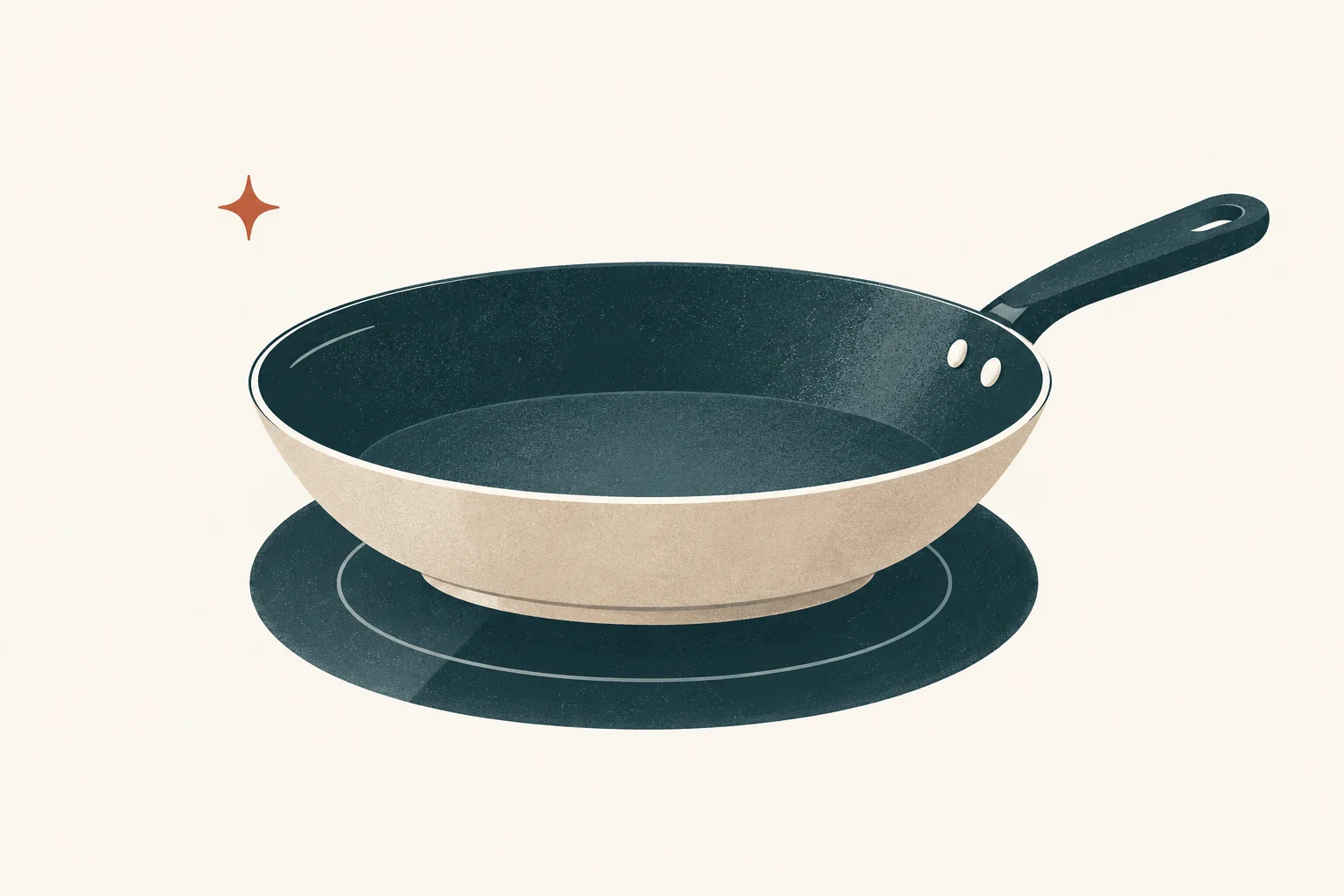
Match the flat contact base to the active element and follow the cooktop manual.
Do not buy yet: A round-bottom wok is not a sensible default for a flat
electric or induction surface. If a wok later earns a place, choose its shape
and material for the exact cooktop and verify the maker’s directions first.
Step 2: Build a stable steamer from an ordinary pot
You do not need a bamboo steamer for the site’s beginner steamed dishes. Start
with a deep pot or wide pan with a lid, a stable metal steaming rack or steamer
insert, and a shallow plate that its manufacturer approves for the intended hot
use. The plate must fit inside with space for steam to move around it.
The Woks of Life documents this ordinary-pot approach in its three steaming
setups: a covered pot or wok,
a heatproof dish, and a support that holds the dish above the water. That is the
same basic arrangement used in this site’s Cantonese steamed dishes
guide.
Perform a cold-fit test
Do this with an empty, cool pot before adding water or turning on the burner.
- Put the rack or insert on the bottom and press it gently from different
directions. It should not rock, fold, or slide. - Center the empty plate on the support. Its rim should not jam against the pot
wall. - Close the lid completely. The lid should not rest on the plate or food.
- Confirm there is room for water below the plate without the bubbling water
touching it. - Plan the lift. Heat-safe mitts and a secure grip must fit into the space. A
plate lifter is optional and should be used only as its maker directs.
Use only a rack, insert, plate, and pot whose manufacturers permit the intended
heat exposure. “Oven-safe” is not a universal promise that an item is suitable
for every stovetop steaming arrangement. Avoid chipped or cracked dishes and
sudden temperature changes unless the maker explicitly allows them.
During cooking, keep the pot on a stable burner and follow the recipe’s water
and heat directions. Water should not touch the plate, and the pot must not boil
dry. Open the lid away from your face and hands so the steam escapes on the far
side.
Success check: The empty plate cannot tip, the lid closes, and you can
lift the plate without improvising around a hot, tight gap.Technique boundary: This guide covers setup selection. Use the exact plate
dimensions, water level, timing, and doneness checks in the individual recipe,
such as Cantonese steamed egg.
Step 3: Set up one knife and a stable board
A Chinese vegetable cleaver is not a beginner requirement. A sharp chef’s knife
or santoku that feels controlled in your hand can handle the slicing, chopping,
and mincing in the current recipe cluster. The Woks of Life likewise notes that
a conventional knife can perform most cutting tasks
in its recipes.
Give that knife a board large enough for the ingredient and the cut. The board
should sit flat. Penn State Extension recommends rubber feet or a damp towel
under the board to prevent
slipping. Keep the towel flat so it does not create a new wobble.
USDA Food Safety and Inspection Service guidance says to wash cutting boards
after use and replace deeply worn boards
when grooves can no longer be cleaned. It also advises considering a separate
board for raw meat, poultry, or seafood and for produce or ready-to-eat food.
Color is optional; clear separation and cleaning are what matter.
You do not need a block full of knives. Add a cleaver later only if you prefer
its tall blade for slicing and transferring prepared ingredients, and learn the
difference between a thin vegetable cleaver and a heavy bone-cutting tool before
buying. Never use a thin blade on bones unless its maker permits that use.
Success check: The board stays still under moderate pressure, the knife
feels controlled, and there is a clear plan for cleaning between raw and
ready-to-eat ingredients.
Step 4: Add measuring and doneness tools
Fast cooking becomes calmer when ingredients are measured before the pan heats.
Use small bowls or plates for cut vegetables, aromatics, protein, and sauce. They
do not need to match or come from a dedicated mise-en-place set.
Keep measuring spoons and a liquid measuring cup nearby. A small digital scale
is useful when a recipe gives grams, but it is not required for every dish. Use
one measuring system consistently within a recipe rather than switching between
an appliance cup, a US cup, and a scale halfway through.
A fast digital food thermometer with a thin sensing tip belongs in the core
setup. Several recipes on this site use thin fillets, small chicken pieces, or a
shallow meat patty. USDA FSIS explains that thin foods should be checked from
the side
so the sensing area reaches the center. It also distinguishes thin-food-capable
thermocouple or thermistor models from common dial probes that need much deeper
insertion.
Before buying, read the thermometer’s stated sensing location, insertion depth,
response time, temperature range, cleaning instructions, and calibration
method. A thin-looking probe is not enough if the sensing area is long. Follow
the recipe’s target temperature and check more than one piece when size varies.
Success check: You can place every measured ingredient within reach, and
the thermometer’s full sensing area can reach the center of the food you cook.
Step 5: Decide whether a rice cooker earns its space
A rice cooker can free attention for another dish, but it is not required for
Cantonese home cooking. A saucepan with a well-fitting lid remains a complete
option. The site’s steamed rice guide
covers both routes.
Consider a rice cooker when you make rice often enough that repeatability and a
keep-warm function solve a real scheduling problem. Before choosing one, check:
- the minimum and maximum batch sizes you will actually cook;
- counter height, ventilation clearance, and storage space;
- whether the inner pot and accessories are practical for you to clean;
- programs for the rice or grain types you use;
- whether the manual explicitly permits mixed rice, steaming, porridge, or
other tasks you expect it to perform.
Do not transfer one cooker’s cup, water line, or program to another model.
Zojirushi’s current rice-cooker FAQ
tells owners to use the supplied rice cup and explains that different grains
need different water amounts and settings. Treat that as a reminder to read
your appliance’s manual, not as a universal formula.
A rice cooker is also not evidence that an untested one-pot recipe will work.
Added meat, vegetables, sauces, and fat change liquid, load, heating, and food-
safety requirements. Use only a recipe validated for a named compatible cooker
or follow the appliance maker’s tested instructions.
Success check: You can name the batch size and program you will use, and
the manual supports that use. Otherwise, keep the saucepan.
What not to buy yet
Delay these tools until a repeated task makes the trade-off clear.
| Specialty tool | Wait unless… | Ordinary alternative |
|---|---|---|
| Carbon-steel wok | Your cooktop supports its base, you want to learn seasoning and care, and you stir-fry often | Wide skillet or sauté pan |
| Bamboo steamer | You repeatedly steam dumplings, buns, or several small items and will dry and store it properly | Covered pot, stable rack, heat-safe plate |
| Chinese vegetable cleaver | You have handled one and prefer its height and balance | Sharp chef’s knife or santoku |
| Wok spatula or ladle | You own compatible uncoated cookware and its curved shape solves a real handling problem | Manufacturer-approved turner and spoon |
| Multi-tier metal steamer | One pot and plate cannot hold the volume you regularly steam | Single covered-pot setup |
| Rice cooker | You cook rice often and a model’s documented capacity and programs fit your routine | Lidded saucepan |
| Plate lifter | Frequent steaming makes lifting the plate the main friction point, and the tool fits the plate securely | Dry heat-safe mitts and a vessel with accessible edges |
| Spider strainer, hot-pot set, or clay pot | A specific recipe or recurring meal needs it | Slotted spoon, ordinary pot, or recipe-approved vessel |
This list is deliberately not a verdict on the tools themselves. It protects
counter space and keeps a beginner from learning several new materials and care
routines at once.
Three ways to test your setup
Choose one route and inspect the recipe before cooking.
- Test the wide pan: Make ginger-scallion chicken
stir-fry after confirming the recipe’s
12-inch skillet and two-batch method fit your equipment. - Test the steamer: Choose one dish from the Cantonese steamed dishes
guide and perform its specific
plate, pot, and thermometer checks. - Test the rice method: Use the stovetop or rice-cooker rice
guide with one consistent measuring
system.
If none of those recipes exposes a real equipment gap, you are set. The next
useful addition may be an ingredient rather than a tool; the beginner Cantonese
pantry guide keeps that
list compact too.
Troubleshooting common equipment problems
The pan heats slowly or unevenly
Likely cause: The contact base is much smaller than the active element, the
pan is not compatible with induction, or the batch crowds the cooking surface.
Fix: Check the appliance manual, base size, and magnet contact. Use the
closest matching element and follow the recipe’s batch size. Do not compensate
by heating coated cookware beyond its manufacturer’s limit.
The steaming plate rocks or the lid will not close
Likely cause: The support is unstable, the plate is too wide, or the rack is
too tall.
Fix: Stop before heating. Replace the setup with a stable insert, smaller
manufacturer-approved plate, or deeper covered pot. Do not wedge the lid shut
or balance the plate on loose utensils.
The thermometer cannot read a thin piece reliably
Likely cause: The sensing area is longer than the food is thick or only the
probe tip has entered the center.
Fix: Check the thermometer manual. Insert from the side when appropriate,
or choose a thin-food-capable probe whose sensing area fits the food.
Frequently asked questions
Do I need a wok for Cantonese cooking?
No. A stable wide skillet can cook the current beginner stir-fries on this site.
A flat-bottom wok becomes useful when it matches your cooktop and you want its
capacity and shape often enough to learn its care.
Do I need a bamboo steamer?
No. A covered pot, stable rack or insert, and suitable heat-safe plate can steam
the current recipe cluster. Buy a bamboo steamer when its tiered space and shape
solve a repeated need.
Is a Chinese cleaver better than a chef’s knife?
“Better” depends on the task, blade construction, balance, and the cook’s
control. A sharp chef’s knife or santoku is sufficient here. Do not treat a thin
vegetable cleaver as a bone cleaver.
Can I use a nonstick skillet for stir-frying?
Yes, when the pan maker permits the recipe’s heat and you use compatible
utensils. Do not chase restaurant-level heat or preheat an empty coated pan
beyond its instructions.
Is a rice cooker worth buying for one person?
It can be if its minimum batch, keep-warm behavior, cleaning, and footprint fit
your routine. If you cook rice occasionally, a small lidded saucepan may be the
simpler choice.
Build around the next dish
The compact beginner setup is one cooktop-matched pan, one safe covered-pot
steamer, one controlled knife and stable board, basic measuring tools, and a
thin-food-capable thermometer. Rice can come from a saucepan or a cooker whose
manual fits your routine.
Pick the next recipe you want to make. Check its pan base, plate dimensions,
batch size, and thermometer needs against what you own. If everything fits, you
do not need to buy anything.