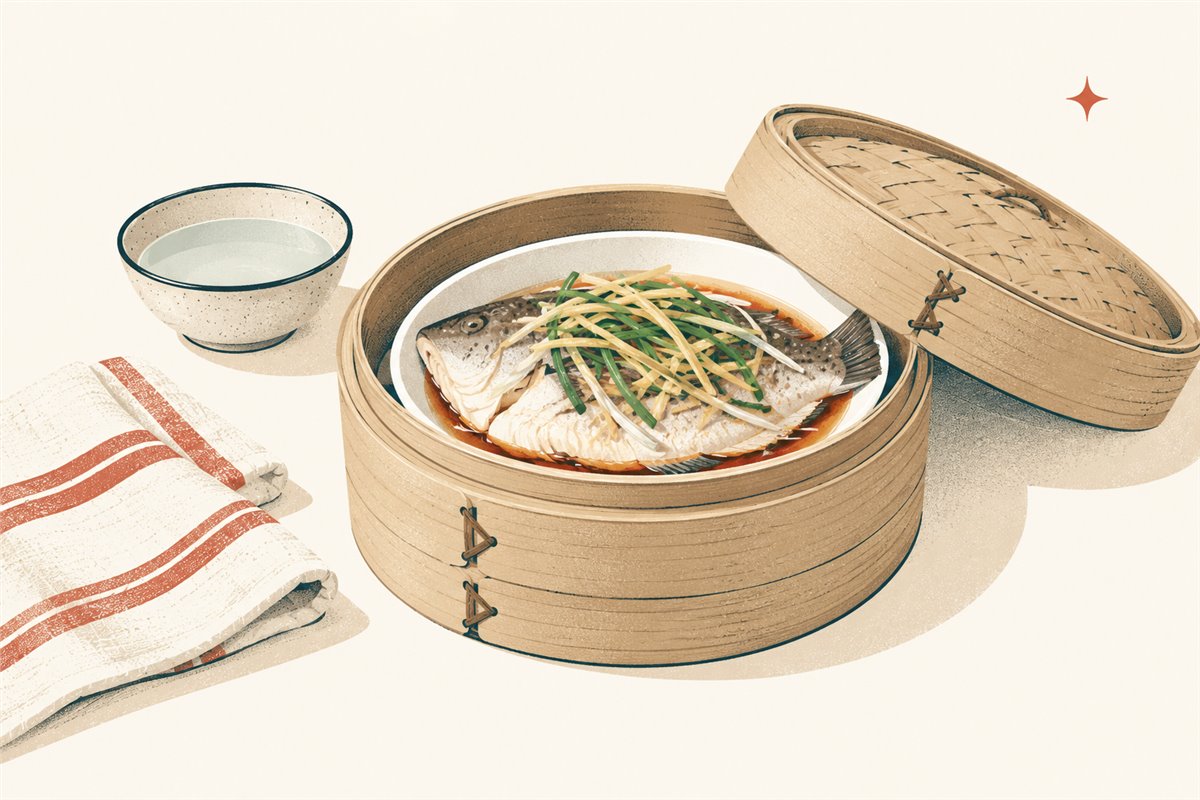
A dedicated bamboo steamer is useful, but it is not the entry fee for Cantonese steamed dishes. The four live recipes in this guide work with a stable rack, a heatproof dish, and a lidded pot, wok, or deep skillet that has enough clearance for steam to move around the food.
The important choices happen before the burner turns on: Does the plate fit? Can the lid close? Is the food shallow enough to heat evenly? Which doneness check does that ingredient require? Use the table below to choose a recipe that fits your time and equipment.
These recipes are source-verified editorial adaptations. Not Hard to Cook does not present them as named-human kitchen tests, and this guide avoids using “authentic” as a blanket promise. Each recipe explains its own Cantonese context or adaptation precisely.
Choose a steamed dish by time and skill
| Recipe | Total time | Difficulty | Dish and pot setup | Main doneness check |
|---|---|---|---|---|
| Cantonese steamed egg | 25 minutes | Easy | 8-inch shallow dish in a lidded pot or wok | Center reaches 160°F/71°C |
| Ginger-scallion fish fillet | 40 minutes | Intermediate | Shallow plate in a 12-inch covered pot or deep skillet | Thickest part reaches 145°F/63°C |
| Cantonese steamed pork patty | 55 minutes | Intermediate | Shallow patty on a heatproof plate in a wide covered pot | Center reaches 160°F/71°C |
| Chicken with shiitake mushrooms | 1 hour 50 minutes | Intermediate | Shallow chicken layer in a wide covered pot | Chicken reaches 165°F/74°C |
The chicken’s total includes one hour of mushroom soaking and marinating. The pork patty includes a 15-minute rest. Those are real parts of the elapsed time, even though the burner is off.
Build a steamer with an ordinary pot
Set up the equipment while everything is cold. This turns a risky improvisation into a quick fit check.
- Place a stable, heat-safe steaming rack inside the pot.
- Set the empty heatproof dish on the rack.
- Close the lid fully. The lid must not rest on the food or tip the plate.
- Confirm that you can lift the dish with dry oven mitts or a plate lifter.
- Remove the dish, then add the amount of water specified by the recipe. The water must not touch the food dish.
Use a manufactured metal rack, a trivet explicitly rated for stovetop heat, or the alternative named in the recipe. Avoid unstable stacks, coated cans, plastic, or an unknown object that could tip, soften, or leach under heat.
The pot also needs enough water to maintain steam for the stated cooking window without boiling dry. More water is not always better: if it reaches the plate, the food is sitting in hot water rather than cooking above it. Follow the selected recipe’s measured setup.
Four live Cantonese steamed dishes
1. Cantonese steamed egg — best first setup
Cantonese steamed egg is the most approachable place to start. Three eggs are measured after beating, then combined with 1.5 times that volume of warm water. That ratio appears in a Hong Kong institutional 蒸水蛋 recipe as well, but the Not Hard to Cook formula remains its own source-verified adaptation.
The mixture is strained into an 8-inch shallow dish and covered before it enters the steamer. Gentle steam and the cover help protect the surface from bubbles and falling condensation. The center should be set with a gentle wobble rather than visible liquid, and the recipe verifies the egg dish at 160°F/71°C.
Choose it when you want to learn the equipment without also managing raw meat. The formula has an optional soy-sesame-scallion finish, so check soy, wheat, and sesame labels if you use it.
2. Steamed fish fillet — best for learning thickness and timing
Steamed fish fillet with ginger and scallion adapts a Cantonese ginger-scallion steamed-fish pattern to fillets and an ordinary home pot. It takes 40 minutes and is intermediate because fillet thickness matters more than weight alone.
Arrange pieces in a single shallow layer rather than stacking them. The steaming time is a starting range; a thermometer in the thickest section verifies 145°F/63°C. Opaque flesh that separates easily is a useful progress cue, but it does not replace the temperature check in this recipe.
Choose fish when you can buy fillets close to the thickness stated in the full method. Read the finishing step before cooking: hot oil, ginger, scallion, and soy require an organized work area, and hot oil must be handled away from water.
3. Cantonese steamed pork patty — best for thermometer placement
Cantonese steamed pork patty is a plain adaptation of the 蒸肉餅 dish family. Its 55-minute total includes mixing, a 15-minute rest, steaming, and the final doneness check.
Patty depth is a cooking control. Spread the mixture to the recipe’s stated thickness in a shallow heatproof plate so the center can heat predictably. Insert a thin probe from the side toward the center; this reaches the coolest point without forcing the tip against the hot plate. Ground pork reaches 160°F/71°C under current FoodSafety.gov guidance.
Choose this dish when you want to practice shaping for even cooking and reading a thermometer in a shallow food. Optional preserved ingredients belong in documented variations, not in an improvised first attempt.
4. Steamed chicken with shiitake — best for advance preparation
Cantonese steamed chicken with shiitake mushrooms uses boneless thigh pieces and dried mushrooms in a wide ordinary-pot setup. Its 1 hour 50 minute total is the longest here because the dried shiitake need advance soaking and the chicken marinates.
Keep the chicken pieces within the specified dimensions and arrange them in a shallow layer. A mound cooks unevenly and makes the center difficult to check. Verify several of the thickest pieces at 165°F/74°C, cleaning the thermometer between checks when needed.
Choose this recipe when you can begin preparation early. The soaking and marinade periods are useful hands-off time, but they are not omitted from the clock. Check sauce labels for soy, wheat, oyster or mushroom ingredients, sesame, sodium, and relevant cross-contact.
Control water, steam, and condensation
“Steam it” is not a complete instruction. Water state, steam intensity, vessel depth, and condensation all affect the result.
Start with the water state in the recipe
Some recipes place the dish over already-boiling water. Others change from a boil to gentler steam after loading. Do not turn that sequence into a universal rule. Made With Lau’s steamed-egg technique, for example, returns the water to a boil and then reduces to a simmer because a fierce boil can disrupt the custard.
Have enough water for the cook, but keep it below the dish. If the recipe requires adding water during a longer cook, use hot water and pour it at the side without splashing the food or creating an unstable rush of steam.
Control condensation at the food surface
A close-fitting lid traps steam, then turns some of it back into water. Cover the food with a heatproof plate or foil only when the selected recipe directs it. That barrier can keep large drops from pitting steamed egg or diluting a sauce.
When you open the pot, tilt the lid away from your face and arms. Let water run away from the food rather than across it. Steam can burn before a person has time to react, and the serving dish will be hot even if it does not look hot.
Keep the dish shallow
Thickness changes heating time. A broad, shallow layer lets steam reach the food evenly and makes the center easier to measure. Do not double a recipe in the same plate; a deeper mass needs a newly verified time and may not fit the package’s safety method.
Know when the dish is done
Texture cues and safety checks answer different questions. A steamed egg’s gentle wobble describes its set. Fish turning opaque describes cooking progress. Clear chicken juices or a firm pork patty can warn that the dish is changing. None of those observations alone verifies the endpoint required by the linked recipe.
FoodSafety.gov’s current safe minimum temperature chart lists:
- 160°F/71°C for egg dishes;
- 160°F/71°C for ground pork and other ground meats;
- 165°F/74°C for chicken and other poultry; and
- 145°F/63°C for fish.
Insert a clean, thin probe into the center or thickest part without touching the plate. For several chicken pieces, check more than one. Clean the probe after each use, and never return a thermometer contaminated by raw food to cooked food without washing it.
Frequently asked questions
Do I need a bamboo steamer?
No. A lidded pot, wok, or deep skillet can work when it fits a stable heat-safe rack and the recipe’s dish. A bamboo steamer is one tool, not proof that the setup is suitable for a particular plate or food depth.
Should I start with cold or boiling water?
Follow the individual recipe. The water state is part of its timing and texture method. Starting cold when the recipe assumes boiling water delays the cook; keeping a rolling boil when it calls for gentle steam can make steamed egg coarse and accelerate evaporation.
Why is there water in my dish?
The usual sources are lid condensation, a food cover that was omitted or displaced, or liquid released by ingredients in an overly deep layer. Check that the lid closes, use the directed cover, and keep the food at the specified depth. Do not pour off cooking liquid unless the recipe tells you to; it may be part of the sauce.
How should I store steamed-dish leftovers?
Transfer perishable leftovers to shallow containers and refrigerate them within two hours. Use refrigerated leftovers within three to four days and reheat them to 165°F/74°C. Texture changes sooner than safety windows: steamed egg and fish are usually best reheated gently and only once.
Measure the pot, rack, and plate first. Then choose the recipe whose full elapsed time and doneness check fit tonight’s meal.