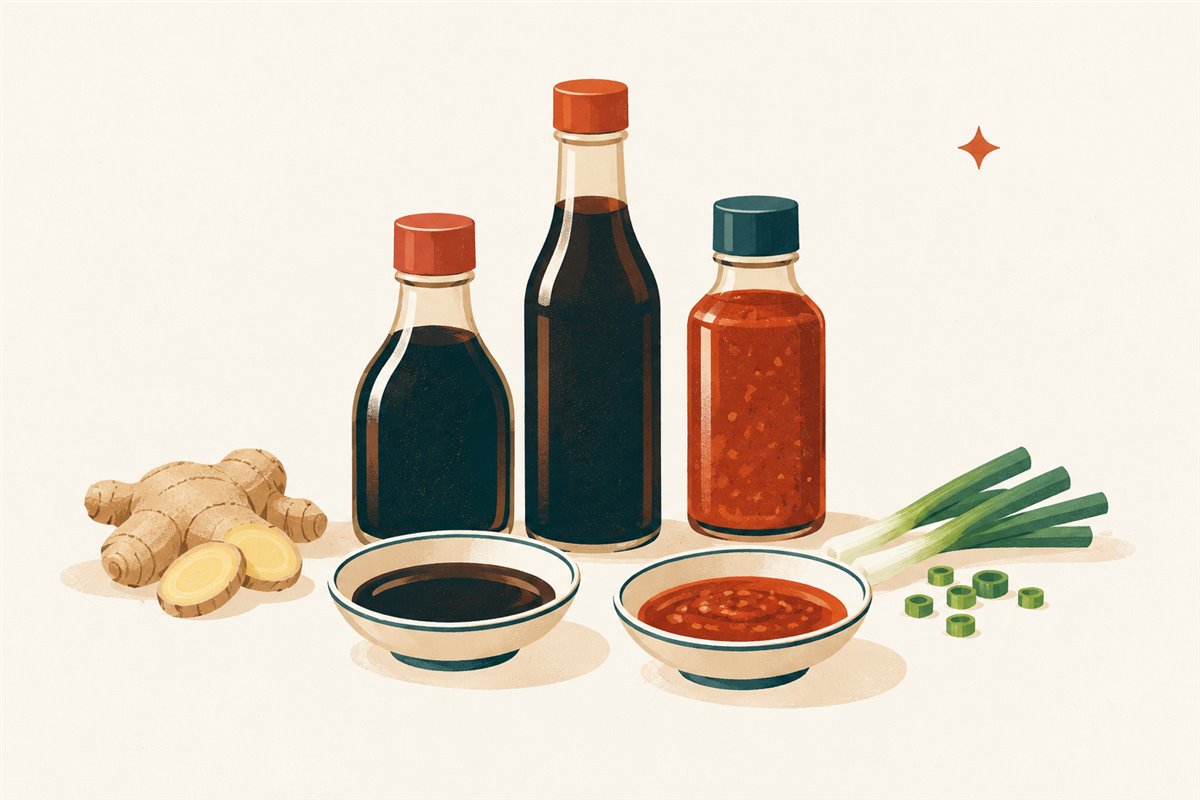
The most useful Cantonese sauces are not interchangeable. Light soy sauce seasons. Dark soy sauce deepens color. Oyster sauce or vegetarian mushroom stir-fry sauce supplies a concentrated savory-sweet base. Toasted sesame oil adds aroma in small amounts. Fermented black beans are a recipe-specific ingredient, not a bottle every beginner needs immediately.
That division of labor matters more than owning a crowded shelf. Buy the bottle required by a recipe, measure it before cooking, and learn what changed before adding another sauce.
Read the whole label: Soy, wheat, and sesame are among the nine major allergens recognized in US food labeling law. Conventional oyster sauce contains oyster, a mollusc, and may also contain wheat or soy. US law does not classify molluscan shellfish the same way it classifies crustacean shellfish for major-allergen labeling, so the full ingredient list still matters. Product formulas can change.
Quick sauce comparison
| Ingredient | Main job | Label cue | Live recipe to start with |
|---|---|---|---|
| Light soy sauce | Salt and savory seasoning | Chinese light soy sauce; “light” does not mean reduced sodium | Steamed fish with ginger and scallion |
| Dark soy sauce | Deeper brown color and fuller soy character | Chinese dark soy sauce; check soy and wheat | Cantonese soy sauce pan-fried noodles |
| Oyster sauce | Concentrated savory-sweet body | Oyster extractives may appear; check wheat and soy too | Bok choy with oyster sauce |
| Vegetarian mushroom stir-fry sauce | Mushroom-forward alternative in recipes that allow it | “Vegetarian” does not mean soy-free or wheat-free | Bok choy variation |
| Toasted sesame oil | Roasted aroma in a marinade, sauce, or finish | Sesame oil; use the recipe’s small measured amount | Cantonese steamed egg |
| Fermented black beans | Salty, fermented soybean flavor in specific dishes | Whole fermented black soybeans; not sweet black bean sauce | No current live recipe—wait to buy |
Light soy sauce: the seasoning bottle
Chinese light soy sauce is the workhorse seasoning in this site’s Cantonese recipe cluster. It seasons without adding the same deep color as dark soy sauce. The word light describes the style; it is not a promise of reduced sodium.
A current Lee Kum Kee US premium soy sauce, for example, lists water, salt, soybeans, sugar, and wheat flour. That tells you two useful things: a conventional bottle may contain both soy and wheat, and one manufacturer’s formula cannot stand in for every brand. Compare the ingredient list and nutrition panel on the actual bottle.
Measure light soy into a small bowl before the pan gets hot. This prevents a freehand pour from turning a sauce salty and lets you combine starch, water, sugar, or other ingredients evenly.
Current live uses include:
- Cantonese steamed pork patty and steamed chicken with shiitake mushrooms use it in measured marinades.
- Steamed fish with ginger and scallion dilutes it for a restrained finish.
- Cantonese steamed egg uses it as an optional topping.
- Ginger-scallion chicken stir-fry and soy sauce pan-fried noodles use it as part of a larger seasoning system.
Can tamari or reduced-sodium soy replace it?
Sometimes, but not silently. Tamari, wheat-free soy sauces, and reduced-sodium products differ in salt, aroma, color, and allergen handling. “Gluten-free” is a label claim to verify on the exact product, not something to infer from the word tamari. Follow the substitution note in the individual recipe; otherwise begin with less and adjust only when it is safe to taste.
Dark soy sauce: color with seasoning
Dark soy sauce is not simply “more soy sauce.” A current Lee Kum Kee US dark soy sauce describes color as a central function and lists both soybeans and wheat. In a finished dish, it can give noodles or braises a deeper brown appearance while adding its own fuller character.
The site’s Cantonese soy sauce pan-fried noodles makes the difference visible: light soy provides most of the seasoning, while a smaller amount of dark soy changes the color and flavor profile.
Do not solve a missing dark-soy bottle by pouring in more light soy without considering salt. In the noodle recipe, replacing the dark soy with the stated amount of light soy produces a paler and potentially saltier result. Other recipes may be better with the dark soy omitted. Use the recipe-specific direction.
Oyster sauce: concentrated body and savory sweetness
Oyster sauce is thicker than soy sauce and brings concentrated savory-sweet flavor that clings to vegetables and stir-fries. It should support the main ingredients rather than become an automatic extra spoonful in every dish.
One current Lee Kum Kee Panda Brand US formula lists oyster extractives and wheat flour. Formulas vary, so check for oyster, wheat, soy, and any other ingredients relevant to your household. Do not rely only on a front-label phrase.
Use it in:
- Bok choy with oyster sauce, where it is diluted and lightly thickened rather than poured straight over the greens;
- Ginger-scallion chicken stir-fry, where it is part of a measured sauce;
- the optional saucier variation in garlic choy sum stir-fry, not the recipe’s simpler base version.
Vegetarian mushroom sauce is an alternative, not a clone
A vegetarian stir-fry sauce can replace oyster sauce in recipes that explicitly allow it. Expect mushroom-forward flavor instead of oyster’s briny depth. A current Lee Kum Kee vegetarian stir-fry sauce still contains soy sauce made with soy and wheat, so “vegetarian” does not imply allergen-free.
The bok choy and ginger-scallion chicken recipes each give an amount and explain how to manage the changed salt balance. Use those directions instead of assuming every oyster-sauce recipe accepts a one-for-one swap.
Toasted sesame oil: aroma, not the main frying fat
Toasted sesame oil contributes a strong roasted aroma in a small volume. In this beginner pantry, it belongs in a marinade, sauce, egg mixture, or final drizzle—not as the default oil for heating a skillet.
That is why recipes use teaspoons rather than a panful:
- Cantonese shrimp and scrambled eggs adds it to the egg mixture.
- Cantonese steamed egg uses it as an optional finish.
- Cantonese steamed pork patty, ginger-scallion chicken, and steamed chicken with mushrooms use measured amounts in mixtures or marinades.
- Soy sauce pan-fried noodles includes half a teaspoon in its premixed sauce.
If sesame cannot be used, omitting the oil is often clearer than replacing it with another strong flavored oil. The dish loses roasted sesame aroma. A neutral oil can sometimes preserve lubrication, as the shrimp-and-egg recipe explains, but it cannot reproduce sesame flavor.
Fermented black beans: buy for a named recipe
Fermented black beans, often sold as salted or preserved black beans, are soybeans fermented with salt. They are not the same product as a bottled sweet “black bean sauce,” and their salinity and added ingredients vary.
There is no verified public recipe in the current Not Hard to Cook cluster that requires them. That makes the beginner recommendation simple: do not buy them yet. When a tested or source-verified recipe is published, its ingredient list should specify whole beans or a prepared sauce, the amount, rinsing or chopping instructions, allergens, and an honest substitution path.
This restraint keeps a specialty ingredient from becoming decorative pantry clutter.
A safer way to season without oversalting
- Read the recipe and bottle labels before cooking. Check whether broth, cooking wine, noodles, or another sauce already contributes salt.
- Measure every sauce into a small bowl. Do not free-pour over a hot pan.
- Use light and dark soy for their stated jobs instead of treating them as cumulative upgrades.
- If using an unfamiliar brand, add the lower end of any optional range.
- Taste only when the food is safe to eat, then adjust in small amounts.
- Serve a salty dish with plain rice or unseasoned vegetables rather than adding a sweetener and hoping it erases the salt.
Water can loosen an overly concentrated sauce, but it cannot remove salt already added. Prevention is the useful technique.
Storage: the bottle’s direction wins
There is no responsible universal after-opening rule for every product in these categories. Formulas, packaging, preservatives, and manufacturer directions differ.
Kikkoman’s current US FAQ, for example, says its Less Sodium Soy Sauce should be refrigerated after opening, advises keeping its sesame oil in a cool, dark cupboard, and recommends using its sauces within one month after opening for best quality. Those are manufacturer instructions for Kikkoman products—not blanket rules for all soy sauces or sesame oils.
For your bottle:
- follow its printed after-opening direction;
- close the cap cleanly and tightly;
- store it away from heat and direct light unless the label says otherwise;
- write the opening date on the bottle if that helps you track it;
- discard a product with damaged packaging, mold, gas, an unexpected odor, or another spoilage sign.
Cantonese use and broader cooking are separate questions
Soy sauces, oyster-style sauces, sesame oil, and fermented bean products appear in many regional Chinese traditions and in cooking far beyond China. That wider use does not make every recipe Cantonese, and Cantonese quantities do not transfer automatically to another cuisine.
Use this guide to understand bottle functions in the site’s Cantonese recipes. For an international recipe, follow that recipe’s product type, amount, cultural context, and substitution guidance. Avoid treating “Asian sauce” as one flavor category.
What to buy first
For the current recipe library, start with light soy sauce. Add oyster sauce or a vegetarian mushroom stir-fry sauce when cooking bok choy or ginger-scallion chicken. Buy toasted sesame oil if several planned dishes use it. Add dark soy sauce for the pan-fried noodles. Leave fermented black beans on the shelf until a recipe you intend to cook calls for them.
That order gives every bottle a job before it comes home.
Frequently asked questions
Is light soy sauce lower in sodium?
Not necessarily. “Light” identifies the soy-sauce style. Look for a specific reduced- or less-sodium statement and compare the nutrition panel.
Can I use dark soy sauce instead of light soy sauce?
Not as a default one-for-one substitution. Dark soy changes color and flavor, while salt levels vary by product. Follow the individual recipe.
Is vegetarian oyster sauce free from soy and wheat?
No such assumption is safe. Some mushroom-based vegetarian stir-fry sauces contain both soy and wheat. Read the complete label.
Is oyster a major allergen under US labeling law?
Oyster is a mollusc. The FDA’s current guidance distinguishes molluscan shellfish from crustacean shellfish in the statutory major-allergen definition. That legal distinction does not make oyster safe for someone allergic to it; read the ingredient list and follow appropriate medical advice.
Do I need fermented black beans for beginner Cantonese cooking?
Not for the site’s current live recipe cluster. Buy them when a specific recipe supplies an amount, preparation method, and storage guidance.
Sources
- FDA: Food Allergies
- FDA: Questions and Answers Regarding Food Allergens, Edition 5
- Kikkoman USA: Frequently Asked Questions
- Lee Kum Kee USA: Premium Soy Sauce
- Lee Kum Kee USA: Premium Dark Soy Sauce
- Lee Kum Kee USA: Panda Brand Oyster Flavored Sauce
- Lee Kum Kee USA: Vegetarian Stir-Fry Sauce
- Lee Kum Kee USA: Pure Sesame Oil
- MICHELIN Guide: Essential Cantonese Sauces Explained